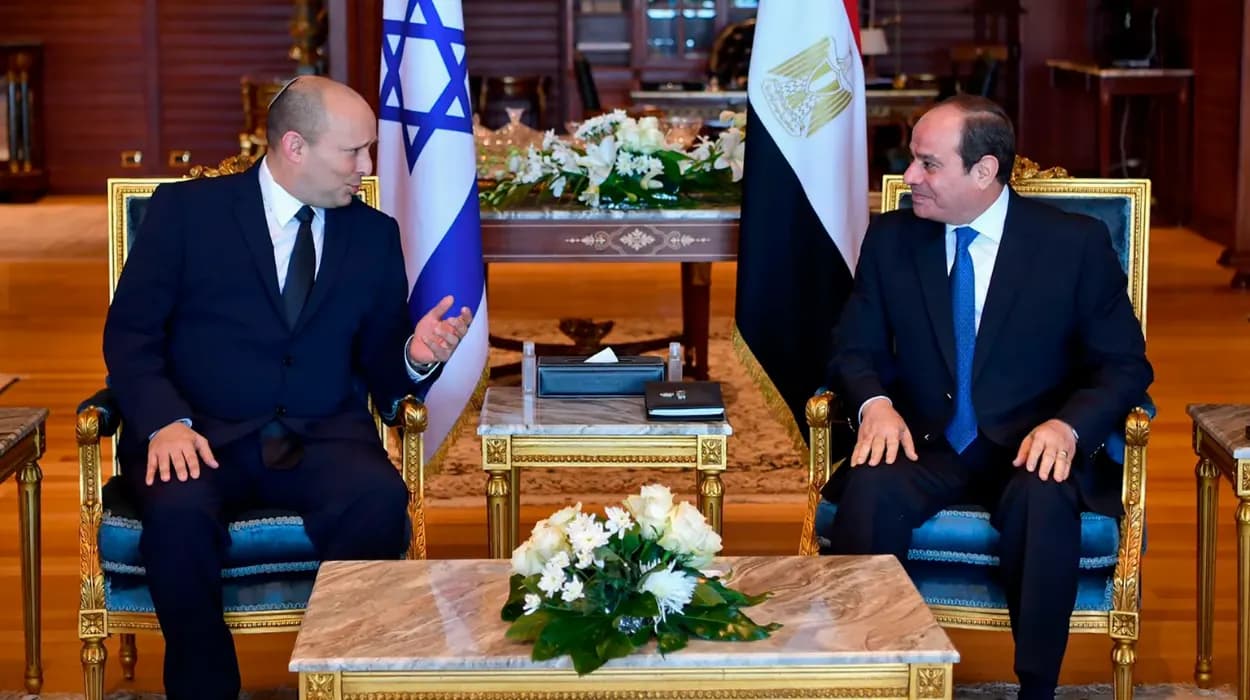
Egypt, Israel, and Palestinian entities engage in structured border cooperation primarily along the Gaza Strip's frontiers with Egypt's Sinai Peninsula and Israel, focusing on security, humanitarian access, and limited trade. This framework, anchored in the 1979 peace treaty, manages critical crossings like Rafah and the Phildelphi Corridor to mitigate smuggling, terrorism, and instability spillover. These arrangements have proven resilient across conflicts, enabling controlled flows while prioritizing national security interests for all parties involved.
Historical Foundations
The foundation of contemporary border cooperation traces back to the 1979 Egypt-Israel Peace Treaty, signed on March 26 following the Camp David Accords negotiated by U.S. President Jimmy Carter.
This agreement resolved the 1973 Yom Kippur War aftermath, stipulating Israel's complete withdrawal from the Sinai Peninsula in exchange for normalized relations and demilitarized zones along their 245-kilometer shared border. Specifically, the treaty divided Sinai into three zones: Zone A near the Suez Canal limited to four Egyptian infantry divisions; Zone B allowing four mechanized divisions; and Zone C, adjacent to Israel, remaining fully demilitarized with only civilian police.
A key component was the Philadelphi Accord, an annex deploying 750 Egyptian border guards along the 13.5-kilometer Gaza-Egypt border to prevent arms smuggling into Gaza. Rafah Border Crossing, established in 1982, initially operated under joint Egyptian-Israeli-Palestinian supervision, with Israel holding remote monitoring capabilities until its 2005 disengagement from Gaza. Post-2005, the Philadelphi Protocol expanded Egyptian deployments to 18 posts, incorporating police, military units, and armored vehicles for patrols.
Following Hamas's 2007 takeover of Gaza, Egypt ramped up fortifications. By 2009, a sand barrier was erected, followed by concrete walls extending 10-18 meters underground by 2013, alongside the destruction of approximately 1,400 smuggling tunnels identified through intelligence. In 2014-2015, during Operation Martyr's Son against Sinai insurgents, Egypt created a 5-kilometer buffer zone from Rafah city, demolishing over 2,000 structures and displacing around 2,000 families temporarily while flooding tunnel networks.
By 2025, enhancements included 14 kilometers of 6-meter-high and deep concrete barriers equipped with radar, seismic sensors, and thermal imaging, reducing infiltration attempts significantly.
These measures adhered to Treaty Article VI, which prohibits both parties from using their territory for belligerent acts against the other, and aligned with UN Security Council Resolution 242's emphasis on secure, recognized boundaries. Earlier precedents, such as the 1967 Six-Day War border closures and 1970s blockade disputes, underscored the treaty's role in transforming a conflict zone into a managed frontier.
Key Border Infrastructure

Rafah Border Crossing stands as Gaza's sole non-Israeli land outlet, spanning the 13.5-kilometer Philadelphi Corridor and handling up to 30-50% of pre-conflict passenger and goods traffic. Managed by Egypt's General Authority for Transit Tunnels (GATT) since 2007, operations mandate Palestinian Authority (PA) staffing on the Gaza side, explicitly excluding Hamas personnel following 2015 security closures.
The facility comprises dual terminals: the Gaza terminal under PA control with basic customs, and the Egyptian side featuring advanced X-ray scanners, explosive trace detectors, and vehicle inspection bays capable of processing 600 trucks daily at peak.
Pre-2023 war data indicates Rafah facilitated around 70,000 monthly crossings, including medical patients, traders, and pilgrims, though volumes fluctuated with security protocols. Adjacent infrastructure includes the Salah al-Din Gate for heavy goods and the Egypt-Gaza rail link, sporadically operational for aid convoys from Al-Arish port.
The Philadelphi Corridor itself, a 100-150-meter-wide buffer strip, hosts Egypt's Battalion 82 with approximately 1,200 troops, supported by Israeli surveillance cameras and joint notification protocols. It has intercepted an estimated 80% of smuggling attempts according to bilateral reports. Complementing this, Kerem Shalom serves as a tripartite junction for Israel-Gaza-Egypt goods transit, secured by Egyptian patrols on southern approaches.
Further south, the 245-kilometer Israel-Egypt "smart fence" from Kerem Shalom to Eilat, completed in 2013, integrates motion sensors, unmanned drones, and rapid-response units, blocking over 20,000 irregular African migrants annually before volumes declined post-2020. Inland, Sinai's upgraded Al-Arish-Rafah highway and rail corridors, built with U.S. aid, streamline humanitarian convoys coordinated through 2005-established tripartite committees involving Egypt, Israel, PA, and international observers.
Security Cooperation Mechanisms
Bilateral intelligence-sharing centers in Cairo and Tel Aviv provide real-time data fusion on threats like ISIS-Wilayat Sinai, which launched over 1,000 attacks in Sinai since 2011, including cross-border raids. Joint efforts post-2013 ousted militants from Rafah outskirts, with Egypt declaring Sinai a military zone in 2012 to deploy up to 40,000 troops within treaty limits by 2025.
Specialized tunnel detection units employ ground-penetrating radar, remote-controlled robots, and foaming agents, neutralizing over 2,500 tunnels by 2024. Naval patrols in the Mediterranean and Gulf of Suez, augmented by U.S.-supplied patrol boats, monitor maritime smuggling routes.
In response to the 2023-2025 Gaza conflict, 2024 protocols allowed up to 50 daily evacuations of wounded individuals including combatants via Rafah, subject to Egyptian escorts and Israeli vetting. Egypt consistently rejected proposals for mass Palestinian refugee influxes, citing potential treaty violations and domestic stability risks.
The European Union Border Assistance Mission (EUBAM Rafah), active from 2005-2007, trained over 1,000 Egyptian guards and maintains liaison offices for monitoring. Regular tripartite security meetings at Nitzana crossing address Philadelphi patrols and incident notifications. These layered defenses buffers, walls, tech surveillance correlated with a 95% drop in cross-border attacks from 2011 peaks, per Egyptian security reports.
Diplomatic Mediation Role
Egypt has mediated approximately 80% of Israel-Hamas ceasefires since 2008, positioning Rafah control as a key leverage point. In 2025 Cairo-hosted talks, intelligence chief Abbas Kamel facilitated over 20 rounds, advancing proposals for phased hostage releases in exchange for aid surges and expanded PA authority at Rafah.
Building on the 2014 Shati Accord for Palestinian reconciliation, Egypt conditioned Rafah reopenings on Fatah-Hamas unity governments, training 500 PA guards in Cairo for post-2024 Israeli withdrawals. Diplomatic initiatives incorporated two-state solution outlines from the Arab Peace Initiative, emphasizing 1967 borders.
During the 2024 Rafah incursion, Egypt-PA memoranda ensured transitional staffing mechanisms. Coordination with Qatar, UAE, and the U.S. involved shuttle diplomacy, with Foreign Minister Sameh Shoukri issuing statements reaffirming "no refugees on Egyptian soil" under Camp David commitments. These interventions helped avert the displacement of 1.9 million Gazans, as estimated by UN agencies.
Humanitarian Aid Channels

Rafah has channeled over 500,000 tons of aid during 2023-2025, including flour rations sustaining 2 million Gazans and medical supplies via cold-chain facilities storing 10,000 vaccine doses. Dual inspection protocols by Egyptian and international monitors enable peaks of 600 trucks daily post-truce periods.
Medical evacuations total 40,000 since 2007, with 2024 amendments permitting wounded fighters' passage under strict approvals. Egypt constructed field hospitals in Sinai accommodating 5,000 patients, waiving fees for 80% of aid amid its $10 billion economic strain from COVID-19 and Ukraine war impacts.
Joint UAE-Egypt initiatives deployed 100,000 tents in Muassi and northwest Rafah/Khan Yunis areas, sheltering up to 200,000 displaced persons. Buffer zone expansions, while demolishing 2,239 structures, secured convoy routes from Al-Arish, ensuring uninterrupted flows during escalations.