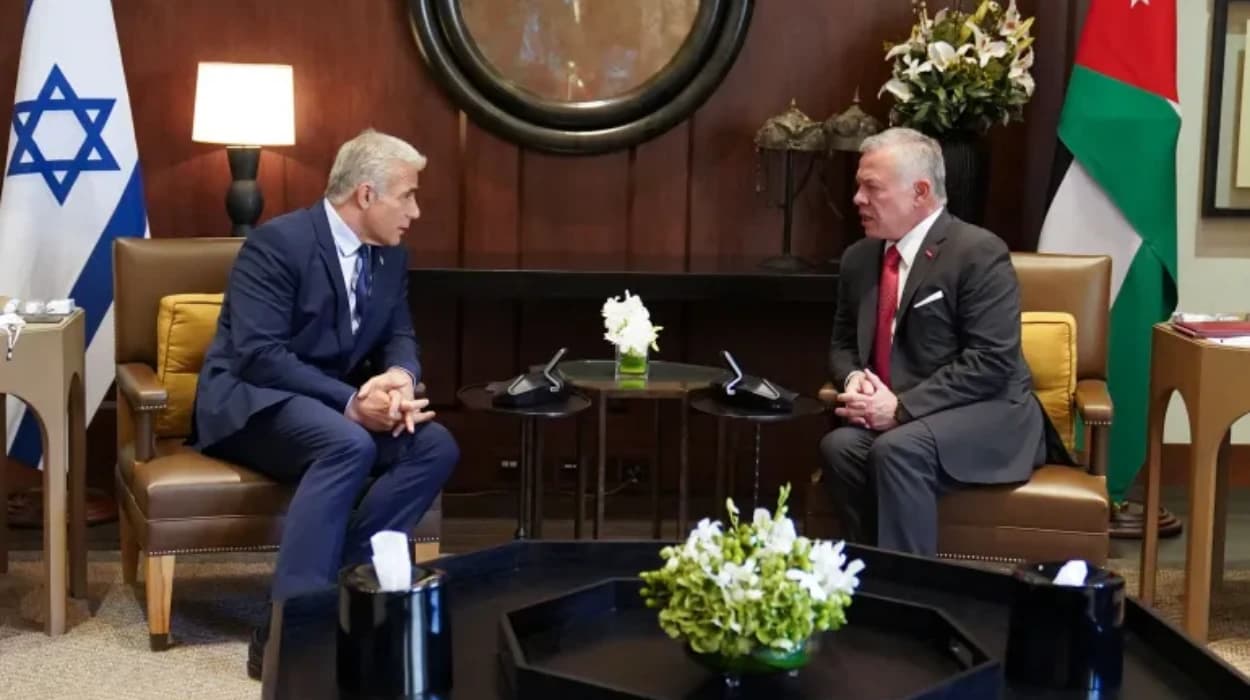
King Abdullah II of Jordan has launched a pivotal joint water-management initiative involving Palestinian authorities and Israel, targeting chronic scarcity across the Jordan River Basin. This trilateral framework builds on longstanding bilateral treaties to enhance resource sharing, infrastructure resilience, and equitable access for over 15 million residents facing climate-induced declines in supply.
Historical Foundations of Water Cooperation
Water-sharing in the Jordan Valley traces to the 1920s British Mandate era, when the Jordan River's 1,800 million cubic meters (mcm) annual flow was first allocated among upstream states. The 1948 Arab-Israeli War prompted unilateral actions: Israel's 1955 Johnston Plan proposed quotas Israel 458 mcm, Jordan 370 mcm, Palestine minimal but was never ratified, leading to the National Water Carrier (1964, 320 mcm capacity) and Jordan's East Ghor Canal (1958, 200 mcm diversion).
The 1967 Six-Day War placed West Bank aquifers under Israeli administration, with 85% of the Mountain Aquifer's 620 mcm yield directed to Israel, leaving Palestinians 40 mcm annually via 118 wells per Oslo II (1995). Gaza's coastal aquifer, 200 mcm capacity, reached 97% salinization by 2023 due to over-extraction and seawater intrusion.

The 1979 Egypt-Israel Peace Treaty indirectly influenced dynamics by stabilizing downstream flows, but Jordan's breakthrough came with the 1994 Wadi Araba Peace Treaty. Signed by King Hussein and Yitzhak Rabin, it allocated Israel 50 mcm from the Yarmouk River, Jordan 200 mcm (Syria capped at 200 mcm), and mandated the Joint Water Committee (JWC) for oversight. The treaty's Annex II envisioned the Al-Wehdeh Dam (110 mcm storage), stalled by funding but revived in talks.
King Abdullah II, crowned in 1999 amid the Second Intifada, prioritized water diplomacy. His 2005 Aqaba summit initiated trilateral dialogues, culminating in the 2013 Red Sea-Dead Sea Conveyance study, a $10-15 billion project to pump 200 mcm from Aqaba, desalinate 100 mcm each for Jordan and Israel, and halt Dead Sea shrinkage (1 meter/year drop). By 2021, a water-for-energy swap emerged: Jordan supplies 50 mcm treated wastewater for Israeli agriculture, receiving equivalent Tiberias freshwater, expanded to 100 mcm by 2025.
Post-2023 Gaza events, Abdullah brokered extensions, doubling treaty volumes amid Jordan's request for one-year renewals.
Launch of the Tripartite Initiative
In early 2025, King Abdullah II convened a landmark Amman summit, inaugurating the Tripartite Water Council with Israel's Water Authority and Palestinian Water Resources Ministry. Attended by UN, World Bank, and Gulf representatives, the launch addressed basin depletion 20% since 2000 per NASA GRACE data projecting 600 mcm deficits in Palestine and 700 mcm in Jordan by 2050 without action.
Abdullah framed it as "peace through pipelines," committing Jordan's Disi Aquifer surplus (150 mcm non-renewable) as a buffer. Objectives: boost supply 150 mcm by 2030, cut losses 25%, achieve 50% reuse. The 50-page charter establishes Amman as secretariat, annual audits, and proportional allocations (population-based: Jordan 11 million, Palestine 5 million, Israel regional share).
Funding kickoff: $50 million UAE seed, $6 billion Green Climate Fund for Aqaba-Amman desalination (300 mcm/year via 300 km pipeline). EcoPeace Middle East's Green Blue Deal pillars cooperation, reallocation, rehabilitation underpin the structure.
Desalination and Conveyance Infrastructure
Jordan's Aqaba plant, solar-powered at 300 mcm capacity post-2025 upgrades, swaps 70 mcm brackish for potable Tiberias water, piping 30 mcm to West Bank cities like Hebron. Israel's Sorek B (200 mcm) allocates 20% trilaterally via 100-km conduits.
The SALAM Initiative models seawater strategies, integrating renewable energy for 600 mcm deficits. Gaza's planned 50 mcm central plant draws Jordanian reverse osmosis tech, operational 2028. Red Sea-Dead Sea link generates 1,100 MW, stabilizing minerals extraction ($1.5 billion economy).

Aqaba-Amman conveyance, GCF-backed, ends rationing for 2 million Amman residents, using energy-efficient pumps.
Aquifer and River Management Protocols
Mountain Aquifer protocols cap extractions: 360 mcm Israel, 118 mcm PA, 142 mcm monitored via 500 telemetry stations (0.1 mcm precision). Yarmouk joint dam revives 110 mcm storage against Syrian upstream barriers.
Eastern Aquifer Basin (Nablus-Tulkarm, 150 mcm) deploys trilateral sensors; Jordan's Arava Institute models recharge. Coastal Gaza aquifers receive 20 mcm desal imports via Ashkelon swaps under Abdullah-brokered truces.
GIS platforms map 2,500 wells, AI detecting leaks in Palestinian networks (35-40% losses vs Israel's 8%).
Wastewater Reuse and Agricultural Networks
Jordan Valley Reuse Plant treats 100 mcm to WHO standards: 40% Jordan, 30% Israel, 30% PA, irrigating 1 million dunums. Jericho Hub saves 40 mcm potable for 50,000 dunums olives/dates. Emirates-Jordan Deir Alla facility processes 80 mcm, boosting women's cooperatives (10 mcm, 2,000 farmers trained). Gaza Northern rehab (30 mcm) pipes via secure corridors. Drip irrigation pilots yield 30% gains, exporting $150 million Israeli tech under QIZ.
JWC+Palestine monthly reviews 1,000 data points; blockchain tracks flows. Cloud seeding (2014 trials) lifts rainfall 15% over 10,000 km². Smart meters on 50,000 PA connections cut theft 20%.
NASA GRACE informs 15% depletion forecasts; Royal Scientific Society trains 600 engineers/year at Amman Water Academy.

Economic and Sectoral Impacts
Agriculture (55-70% consumption) gains $800 million GDP: Jordan potatoes/tomatoes (+$300m), PA citrus (+$250m), Israel exports (+$250m). Dead Sea tourism: 1.5 million visitors with stabilized levels.
20,000 jobs from plants/pipelines; QIZ duty-free boosts $100 million drips. Gaza tankers/swaps deliver 50 mcm emergency; 500 West Bank cisterns rehab (10 mcm). Per capita targets: 100-150 mcm/person (current: Jordan 100, PA 80, Israel 300). Refugee camps prioritize 20 mcm; diarrhea drops 25% in 100 clinics. Abdullah's 50+ addresses since 2000 position water as "conflict prevention." 2024 UNGA ICJ push; resolved 2023 Yarmouk standoff. UAE-facilitated Project Prosperity expands to Palestine.
Navigated Israeli overrides (2022 wells, +50 mcm); Jordan vetoes Tiberias diversions. Climate: 25-30% rainfall drop, +2°C temps strain 1,700 mcm yield. Population: 18 million by 2035.
PA infrastructure: $1 billion rehab needed. Political: Hamas-PA delays, settlements +30 mcm/year. Funding: $3 billion gap; Syrian dams 100 mcm diversion..