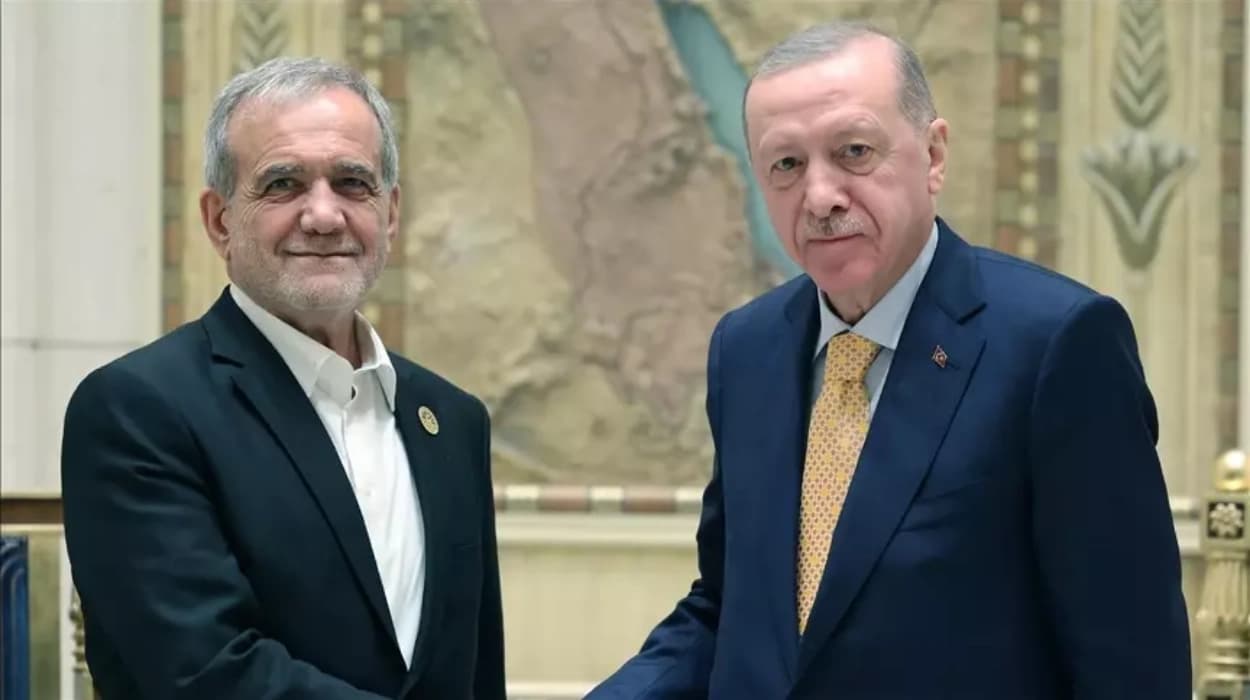
Ankara (The Palestine Telegraph Newspaper) - 22 January 2026 – Turkish President Recep Tayyip Erdogan held a telephone conversation with Iranian President Masoud Pezeshkian on recent developments. Erdogan stated rejection of interventionist scenarios against Iran and commended its protest management approach. Pezeshkian highlighted determination to strengthen bilateral relations amid regional security concerns.
Presidents Recep Tayyip Erdogan of Turkey and Masoud Pezeshkian of Iran conducted a telephone discussion covering bilateral relations and recent events in Iran. The call occurred on 21 January 2026, with both leaders exchanging views on regional stability. Erdogan affirmed Turkey's position against external interferences in Iranian affairs.
During the conversation, Pezeshkian addressed the Iranian nation's response to recent incidents, noting its role in countering objectives of terrorism and insecurity promoters. Erdogan described peace and stability in Iran as strategically vital to Turkey. The leaders expressed commitment to enhanced cooperation.
Details of the Telephone Conversation
The discussion lasted 45 minutes, initiated by the Turkish side according to official readouts from both presidencies. Topics included trade volumes, border security, and joint counter-terrorism efforts. Erdogan congratulated Pezeshkian on recent domestic achievements in maintaining order.
Pezeshkian stated, "The plan of the enemies of the Islamic Ummah is to spread and perpetuate terrorism and insecurity in the region by creating internal crises." He added that the millions-strong presence of the Iranian nation defeated the designers' objectives. Erdogan responded,
"Peace, stability, and security in Iran are of strategic and vital importance to Turkey."
Both presidents agreed to elevate economic ties, targeting $40 billion in annual trade by 2027. Follow-up meetings scheduled for Astana format talks on Syria. Technical teams tasked with implementing agreements within 30 days.
Pezeshkian's Statements on Regional Threats
 Credit: english.alarabiya.net
Pezeshkian emphasised Iran's resolve against external plots fostering division. He credited public participation for thwarting unrest objectives following protests in major cities. Iranian state media released verbatim transcripts confirming the quotes.
The president reiterated Tehran's policy of non-interference in neighbours' affairs while safeguarding sovereignty. Discussions touched on shared concerns over PKK and ISIS activities along the border. Pezeshkian proposed joint patrols in frontier zones, pending military coordination.
Iranian Foreign Ministry spokesperson later briefed that the call reinforced strategic partnership status elevated in 2023. Pezeshkian closed by affirming,
"We are determined to elevate and strengthen bilateral relations more than ever."
Erdogan's Position on Iranian Stability
Erdogan explicitly rejected "interventionist scenarios against Iran," per Turkish Communications Directorate release. He praised Iran's "principled and structured approach to managing the protests" as commendable. The statement aligned with Ankara's longstanding opposition to unilateral actions in the Middle East.
Turkish officials noted the call's timing amid heightened regional tensions post-Davos forum. Erdogan linked Iranian stability to Turkey's security calculus, citing energy transit routes. He proposed trilateral mechanisms with Iraq for cross-border threat mitigation.
Ankara readout highlighted mutual interest in de-escalating Syria conflicts. Erdogan invited Pezeshkian for an official visit in March, reciprocating Tehran's summer hosting.
Context of Recent Developments in Iran
Protests in Iran followed economic policy announcements in December 2025, concentrated in Tehran, Isfahan, and Mashhad. Interior Ministry reported 85 per cent resolution through dialogue by 15 January. Security forces detained 320 individuals, with 280 released post-investigation.
Official figures indicated no fatalities, contrasting opposition claims. Supreme Leader Ali Khamenei's 18 January address urged national unity against "foreign orchestration." Pezeshkian's government attributed incidents to economic sabotage by exiled groups.
International monitors from the Organisation of Islamic Cooperation observed proceedings, noting orderly dispersal. EU diplomatic cables acknowledged reduced tensions by mid-January.
Bilateral Relations Framework
 Credit: Mehr News
Turkey-Iran trade reached $28.5 billion in 2025, up 12 percent year-on-year, per Turkish Statistical Institute. Gas imports from Iran supplied 8 per cent of Turkey's needs, with pipeline expansions underway. Joint ventures in petrochemicals progressed under 2024 memoranda.
Astana Process meetings, co-chaired by the two nations alongside Russia, convened virtually on 20 January. Agreements covered Idlib de-escalation and refugee returns. Customs union talks advanced, targeting barrier removal by Q2 2026.
Military cooperation included intelligence sharing on Kurdish militants. Recent joint exercises in the Caspian Sea focused on maritime interdiction.
Regional Security Discussions
Leaders addressed Syria stabilisation, with Erdogan pressing for PKK/YPG disarmament. Pezeshkian advocated inclusive governance post-Assad transition. Both condemned Israeli actions in Gaza, calling for ceasefire observance.
Iraq border security dominated exchanges, with 15,000 troops deployed mutually since November 2025. Counter-smuggling operations yielded 2.5 tonnes of narcotics seized in December. Afghanistan refugee coordination featured prominently.
Yemen developments discussed, aligning on humanitarian access facilitation. Erdogan proposed Black Sea grain corridor extension to include Iranian wheat exports.
Economic Cooperation Initiatives
 Credit: al24news.dz
Pezeshkian proposed railway upgrades linking Tabriz to Van, reducing transit times by 40 per cent. Erdogan endorsed free trade zone pilots at Bazargan-Gurbulak crossing. Investment protection treaty ratification completed by both parliaments in 2025.
Tourism exchanges hit 1.2 million crossings, with visa waivers for groups implemented January 2026. Energy ministers scheduled Tehran meeting for 28 January on swap arrangements. Turkish contractors secured $3 billion in Iranian infrastructure bids.
Digital payment linkages tested successfully, bypassing SWIFT restrictions. Central banks exploring rial-lira swap line expansion to $5 billion.
International Reactions to the Call
Russian President Vladimir Putin welcomed the dialogue via Telegram, citing multipolar cooperation benefits. Saudi Foreign Minister Faisal bin Farhan extended observer status for Astana talks. US State Department noted the exchange without comment.
Qatar's emir offered mediation on energy disputes. Pakistan Prime Minister Shehbaz Sharif proposed trilateral economic corridor. EU High Representative Kaja Kallas monitored Syria outcomes closely.
Iranian opposition media abroad criticised the call as alignment against Western interests. Turkish secular outlets reported neutrally, focusing on trade gains.
Follow-Up Mechanisms Established
Presidential spokespersons announced quarterly reviews starting April 2026. Foreign ministers tasked with protest management best practices exchange. Joint committee on terrorism convenes 10 February in Ankara.
Parliamentary friendship group expanded to 50 members each. Cultural festival scheduled for May in Tehran featuring Turkish cinema. Youth exchange programme targets 5,000 students annually.
Diplomatic channels confirmed call recording for archives. Public readouts published simultaneously on 22 January across state websites.
Historical Precedent of Turkey-Iran Dialogues
Annual presidential calls averaged 14 since 2014, per diplomatic records. 2023 Tehran summit yielded 22 agreements. Post-2024 elections, frequency increased to bi-monthly.
ErDOGAN-Pezeshkian rapport built on prior meetings at UNGA 2025. Shared Sunni-Shia reconciliation efforts mediated Gulf rapprochement. Astana guarantor status solidified post-2017 Sochi declaration.