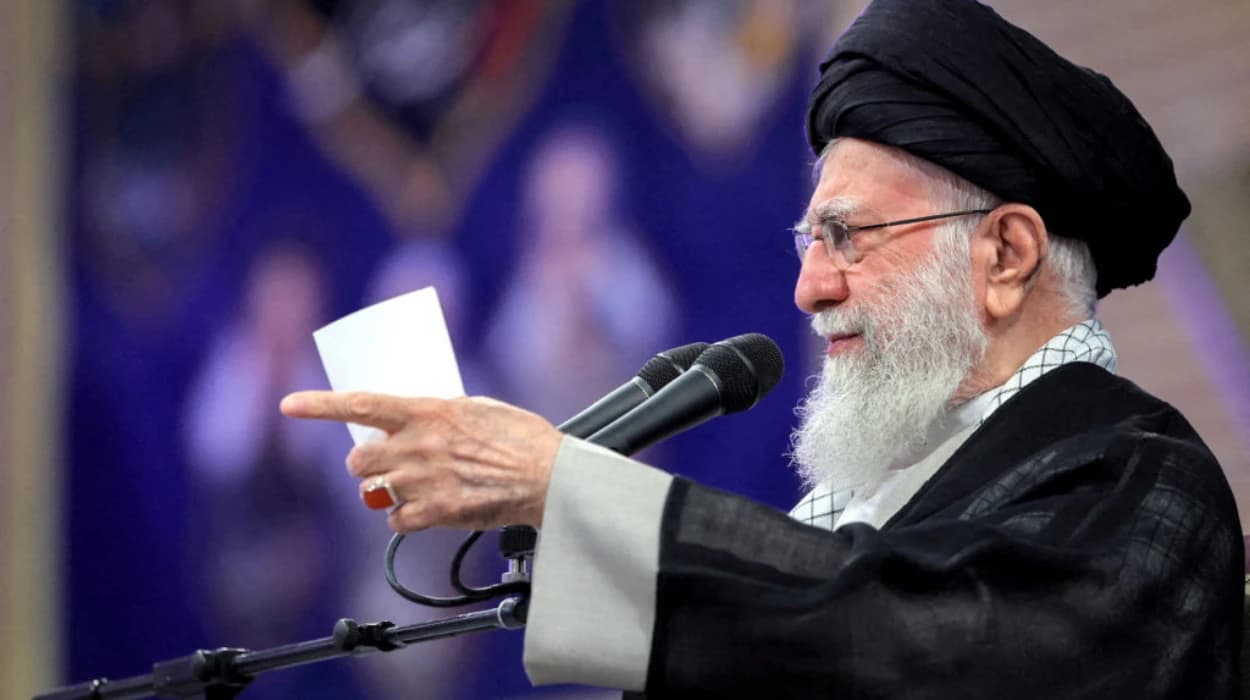
Iran (The Palestine Telegraph Newspaper) February 01, 2026 – Iran’s Supreme Leader Ayatollah Ali Khamenei has warned that any United States military attack on Iran would trigger a “regional war” across the Middle East, as tensions escalate over Washington’s threat of possible strikes and the European Union’s move to add Iran’s Islamic Revolutionary Guard Corps (IRGC) to its terrorist list.
He said Iran does not seek conflict but pledged a forceful response to any assault, while President Donald Trump has ordered additional US naval deployments near Iran and warned that time is “running out” for Tehran over its nuclear programme and crackdown on protests.
The EU’s designation of the IRGC as a terrorist
organisation, following what European officials described as the most violent
repression of demonstrations in Iran’s recent history, has drawn a retaliatory
response from Tehran, which now labels the armies of certain EU states as
“terrorist groups.”
These developments come amid continuing scrutiny of Iran’s domestic situation
after months of nationwide protests and international concern over earlier
reports of schoolgirls’ poisonings and security crackdowns.
Khamenei Issues Warning Of ‘Regional War’ In Case Of US Attack
Iran’s Supreme Leader Ayatollah Ali Khamenei stated on Sunday that any US military action against Iran would escalate into a broader “regional war” in the Middle East. He delivered the warning in a speech in Tehran as the United States maintains forces in the region and signals it is prepared to respond militarily to Iran’s handling of domestic unrest and regional activities.

Khamenei, who has held ultimate authority in Iran for nearly four decades, said Iran does not intend to initiate hostilities but will respond if attacked. He was quoted as saying that
“if they initiate a war this time, it will escalate into a regional war”
and that the Iranian people would “strike back forcefully” against any party seeking to attack or cause harm.
According to state-linked reporting, Khamenei described Iran as non‑aggressive and emphasised that the country does not seek to attack other nations. However, he underlined that any assault on Iran would meet a decisive reaction, framing the warning as directed at the United States and its regional posture.
US Military Posture And Warnings From President Trump
Khamenei’s remarks coincided with an increased US military presence near Iran, including the deployment of the USS Abraham Lincoln and associated naval forces to the Arabian Sea. President Donald Trump ordered the deployment following Tehran’s violent response to widespread protests across the country, according to US media reports.
President Trump has publicly indicated that Washington is prepared to take military action if Iran does not alter its course on its nuclear programme and domestic crackdown. He has said that a “massive Armada” is heading toward Iran “with great power, enthusiasm, and purpose,” and warned that time was “running out” for Tehran to reach an agreement.
The US president has further cautioned that any future attack ordered by Washington could be “far worse” than previous US strikes on Iran if negotiations fail. At the same time, he has urged Iran to “come to the table,” tying the prospect of military escalation to outcomes in both nuclear diplomacy and the authorities’ treatment of demonstrators.
EU Formally Adds Iran’s Revolutionary Guards To Terrorist List
On 29 January 2026, the European Union formally placed Iran’s Islamic Revolutionary Guard Corps on its list of terrorist organisations. EU officials said the decision was a response to what they described as a violent crackdown and massacres during the 2025–2026 protests in Iran.
EU foreign ministers meeting in Brussels agreed new sanctions on individuals and entities linked to the crackdown and Iran’s support for Russia, and also reached a political agreement to add the IRGC to the EU’s terror list. The designation places the IRGC alongside groups such as al‑Qaeda and the Islamic State (ISIS) under the bloc’s counter‑terrorism framework.

EU High Representative and senior officials said repression in Iran “cannot go unanswered,” describing the events as the most violent repression in the country’s modern history. France, which had earlier expressed concern about the diplomatic implications of such a move, signalled that it would back the listing and subsequently aligned with member states that had advocated for the designation.
Tehran’s Retaliatory Declaration Against Certain EU Armies
Iran responded to the EU decision by announcing that it now considers the armies of those EU countries that have listed the IRGC as terrorist organisations to be “terrorist groups” themselves. Iranian Parliament Speaker Mohammad Baqer Qalibaf made the statement on Sunday, describing the move as a retaliatory measure.
Qalibaf’s remarks followed the EU’s formal listing of the IRGC and signalled an escalation in the diplomatic confrontation between Tehran and European capitals. The Iranian position broadens the dispute beyond targeted sanctions, characterising certain European armed forces as equivalent to groups designated under terrorism legislation.
The statement adds to strained relations between Iran and the EU, which has already imposed multiple rounds of sanctions over human rights concerns and alleged arms transfers to Russia. European officials have previously said additional measures would remain under consideration depending on developments inside Iran and in the wider region.
Protests In Iran And International Concern Over Crackdowns
The EU’s terror listing and the latest warnings by Khamenei occur against the backdrop of months of protests in Iran that began in 2025 and continued into 2026. European diplomats and officials have described the authorities’ response as the most violent repression since the establishment of the Islamic Republic in 1979.
The protests followed earlier waves of unrest that started in 2022 after the death of Mahsa Amini while in the custody of Iran’s morality police over alleged violations of the country’s hijab rules. Subsequent demonstrations saw schoolgirls and young women participating in unprecedented numbers, prompting a forceful response from security forces, according to rights groups and international observers.
Throughout these periods, Western governments and international organisations have urged Iran to respect the right to peaceful assembly and to allow independent investigations into alleged abuses. Tehran has rejected external criticism, framing the unrest as influenced by foreign interference and hostile media while insisting it is addressing security concerns under national law.
Earlier Poisonings Of Schoolgirls And Khamenei’s Past Statements
In 2023, Iranian authorities faced domestic and international scrutiny over a series of reported poisonings affecting schoolgirls across multiple provinces. State media and officials reported that more than 1,000 students had fallen ill since November of that year, with incidents beginning in the city of Qom and spreading to other areas.
Khamenei at the time described the poisoning of schoolgirls as an “unforgivable” act and called for a thorough investigation. He said that if it were proven that the attacks were intentional, those responsible should face the death penalty, according to Iranian state television.

Parents of affected students took to the streets in several cities to demand accountability and assurances of safety, while some activists accused hard‑line elements of seeking to intimidate girls who opposed strict dress codes. Iranian officials rejected such accusations and said they were examining possible causes, while international actors, including the White House, called for independent inquiries and raised the issue in relation to broader human rights concerns in the country.
Broader International Designations Of The IRGC And Future Steps
Beyond the European Union, several countries had already designated the IRGC as a terrorist organisation before the latest decision in Brussels. According to publicly available records, states including Australia, Canada, the United States, Israel, Saudi Arabia, and others classify the IRGC as a terror group under their national frameworks.
The EU’s move on 29 January 2026 adds the bloc’s collective weight to those designations and is accompanied by additional sanctions targeting IRGC commanders and affiliated entities. Officials have indicated that member states are also coordinating with partners such as the United Kingdom, which is reported to be preparing parallel measures following the EU listing.
Iran has condemned these actions and maintains that the IRGC is a core component of its defence and security apparatus. Tehran argues that international sanctions and terrorism labels violate its sovereignty and undermine regional stability, while Western governments state that the measures are a response to human rights violations and regional activities they deem destabilising.