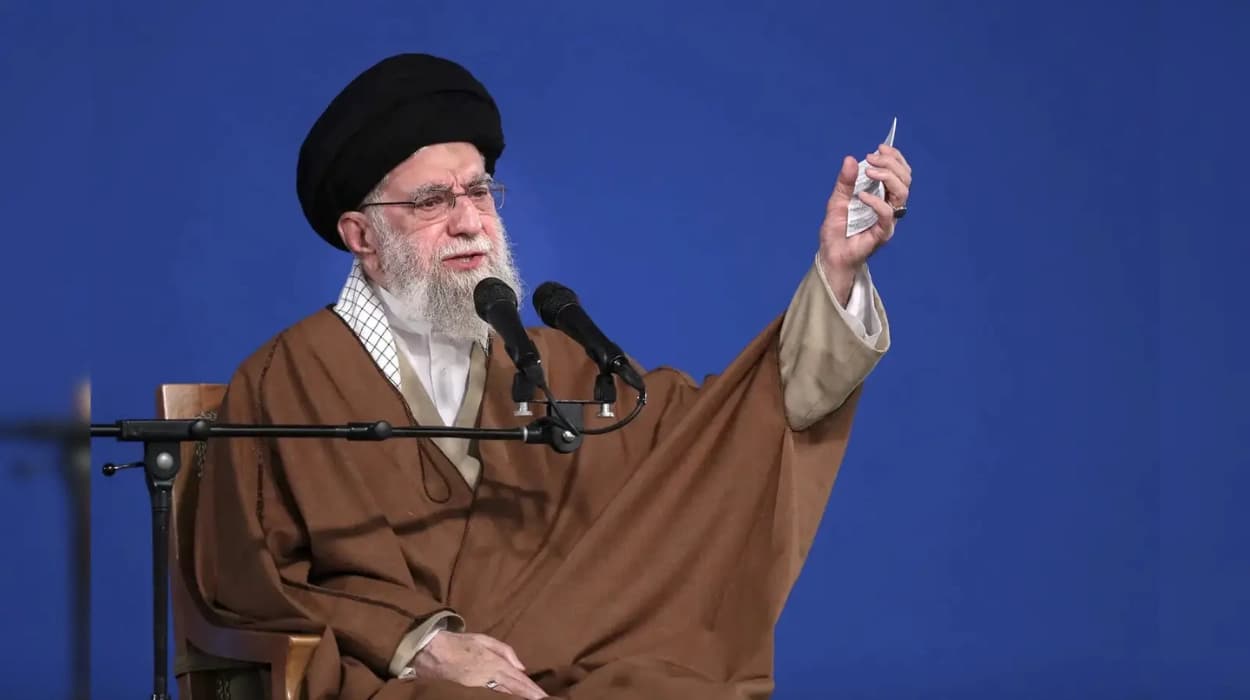
Iran’s Supreme Leader Ayatollah Ali Khamenei stated that cooperation with the United States is impossible unless the US abandons support for Israel, withdraws military bases from the Middle East, and ceases regional interference. Khamenei linked the dispute between Iran and the US to fundamental ideological conflicts and historical grievances dating back to the 1953 coup, emphasising the ongoing US hostility towards Iran.
Iran’s Terms for Cooperation with the US
Ayatollah Ali Khamenei, the Supreme Leader of Iran, declared on November 3, 2025, that cooperation between Tehran and Washington is unattainable as long as the US continues to support Israel and maintains military bases across the Middle East. Speaking to thousands of students and families of martyrs ahead of Iran’s National Student Day, marking the 1979 US Embassy takeover, Khamenei articulated Iran’s conditions clearly.
Tasnim News Agency quoted Khamenei’s statement that cooperation could only be considered if
“the United States ceases supporting the Zionist regime, shuts down its military bases in the region, and stops interfering.”
He further described America’s “arrogant nature” as demanding submission, which he asserted Iran would never accept.
Similarly, Reuters reported Khamenei reiterating that
“cooperation with Iran is not possible as long as the United States continues to support the accursed Zionist regime, maintains military bases, and interferes in the region”.
The Times of Israel detailed Khamenei’s comments as being a response to US President Donald Trump’s prior openness to negotiations, highlighting that despite Washington’s “hand of friendship,” genuine cooperation hinges on Washington relinquishing support for Israel.
Ideological Roots and Historical Context
In a detailed statement covered by Intellinews, Khamenei traced US-Iran tensions back to the 1953 coup that overthrew Prime Minister Mohammad Mossadegh, describing it as a root cause of enduring hostility. He accused the US of cooperating with Britain to reinstate the Shah’s regime, resulting in 25 years of dictatorship backed by Western powers. Khamenei characterised the conflict as ideological, not merely tactical, highlighting America’s hegemonic aspirations as unacceptable to Iran’s independence.
WANA News further captured this perspective, noting Khamenei’s assertion that
“the main cause of the US’s various plots against the revolution is that a valuable asset has been taken from its grasp, ending its dominance over Iran’s resources.”
He referenced sanctions, military confrontations, and the US-backed support of Iraq in the Iran-Iraq war as evidence of America’s longstanding opposition.
Current Regional Dynamics and Military Posture
Khamenei’s recent address also touched on regional military developments. Anadolu Agency reported his remarks on Iran’s capability to deliver stronger military responses against the US and Israel if provoked. He pointed to Iran’s missile strike on the US Al-Udeid Air Base in Qatar as a demonstration of this military resolve.
Arab News, in their coverage from June, recalled Khamenei’s claim of victory over Israel following a 12-day war in which Israel, with US backing, targeted Iranian military and nuclear sites. The ceasefire, brokered partly by the US, came into effect on June 24, but tensions remain high.
Statements from Iranian Officials on US Relations
Iran’s Foreign Minister Abbas Araghchi, in an interview with Al Jazeera reported by Ahram Online, stated that Iran remains open to negotiations with the US but only concerning its nuclear programme, explicitly ruling out any talks on missile capabilities. He emphasized Iran’s readiness to negotiate
“on an equal footing and based on mutual interests,”
stating that neither side is in a hurry.
Iran’s highest leadership has drawn an unmistakable line for future US-Iran relations, conditioning any potential cooperation on the US abandoning its support for Israel, withdrawing military presence from the region, and ceasing interference in Middle Eastern affairs. This stance is deeply rooted in decades of historical grievances and an ideological opposition to US hegemony, as articulated by Ayatollah Ali Khamenei and aligned with statements from senior Iranian officials. The geopolitical rivalry continues amid regional tensions and unresolved conflicts, with diplomatic negotiations contingent on fundamental shifts in US policy as per Iran’s position.