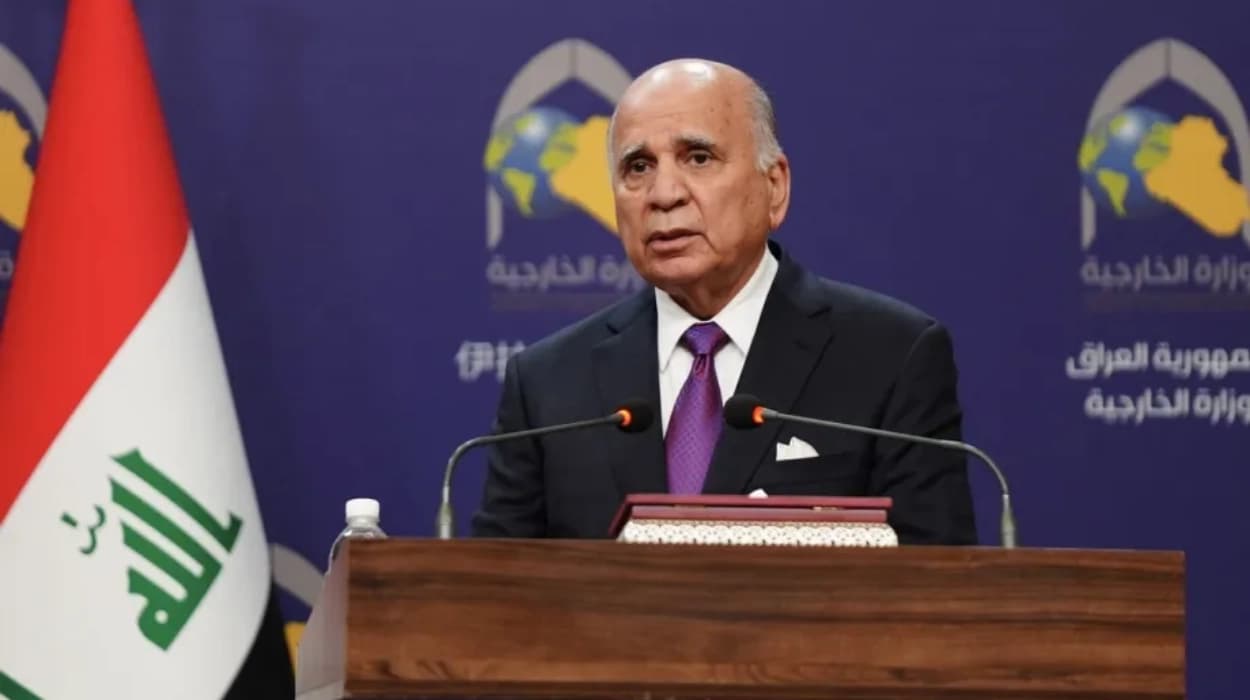
Baghdad (The Palestine Telegraph Newspaper) 24 January 2026 – Iraq's Deputy Prime Minister and Foreign Minister Fuad Hussein stated that Iraq should not shoulder the security and financial burden of ISIS detainees alone. He made the remarks during a phone call with EU Foreign Policy Chief Kaja Kallas, according to the Iraqi Foreign Ministry.
The discussion addressed ISIS detention facilities in Syria following escapes from prisons outside Syrian Democratic Forces control. Both sides reviewed bilateral relations and stressed Europe's role in SDF-Syrian government talks.
Iraqi Foreign Ministry spokesperson Basim Alawadi stated on 24 January 2026 detailing the conversation between Fuad Hussein and Kaja Kallas. Hussein emphasised that responsibility for ISIS prisoners lies with all concerned countries. Kallas thanked Iraq for its preliminary approval to receive transferred detainees. The call covered the security situation in Syria's Hasakah province and ceasefire sustainability.
The US military's Central Command announced on 20 January 2026 the launch of a mission to transfer ISIS detainees from northeastern Syria to Iraq. US forces transported 150 ISIS fighters from a Hasakah province facility to a secure Iraqi location. Plans exist to transfer up to 7,000 detainees to Iraqi-controlled facilities.
Details of Iraqi-EU Telephone Discussion
Fuad Hussein spoke with Kaja Kallas on 23 January 2026 for 40 minutes. The Iraqi Foreign Ministry statement, carried by the Iraqi News Agency, noted review of strong Iraq-EU relations. Both officials discussed enhancing cooperation in mutual interest areas.
Hussein addressed ISIS detention facilities in Syria, particularly after escapes from prisons beyond Syrian Democratic Forces (SDF) control. The statement highlighted concerns over Hasakah province security, with both sides stressing ceasefire maintenance and peaceful resolution of issues.
Kallas acknowledged Iraq's initial acceptance of transferred ISIS fighters. Hussein reiterated that Iraq cannot bear sole security and financial consequences. He called for active European involvement in supporting SDF-Syrian government negotiations for clear agreements.
The Iraqi Supreme Judicial Council announced on 22 January 2026 plans for legal action against transferred ISIS detainees. Courts will process cases under anti-terrorism laws, with proceedings in Baghdad and Erbil facilities.
US-Led Transfer Mission from Syria
 Credit: Izz Aldien Alqasem - Anadolu Agency
US Central Command (CENTCOM) detailed the operation on 20 January 2026, confirming transport of 150 ISIS fighters from Hasakah to Iraq. Apache helicopters and special forces secured the convoy crossing at Al-Waleed border point. Iraqi forces received detainees at Rutba detention centre.
CENTCOM stated the mission ensures terrorists remain in secure facilities amid SDF vulnerabilities. Up to 7,000 foreign ISIS fighters held in 28 SDF camps and prisons face repatriation risks. Previous transfers in 2025 involved 400 fighters from Albania, Germany, and France.
US Secretary of Defense Pete Hegseth approved the operation following SDF requests post-October 2025 prison breaks. CENTCOM reported 120 ISIS suspects escaped Hasakah facilities during clashes with tribal militias. Iraqi intelligence verified 87 recaptured, 33 at large.
ISIS Detention Challenges in Syria
SDF controls northeastern Syria facilities detaining 10,000 ISIS suspects, including 2,000 Europeans. Al-Hol camp houses 45,000 family members, with 8,000 foreign nationals. UN reports document 200 escape attempts since 2024, freeing 350 fighters.
Hasakah province saw intensified fighting after Assad regime advances in December 2025. SDF lost control of three prisons during Turkish-backed offensives. US advisors embedded with SDF reported ammunition shortages and guard desertions.
Iraq hosts 5,200 ISIS detainees in 12 facilities across Nineveh, Anbar, and Salahuddin provinces. Al-Rustam and Camp Justice complexes hold foreign fighters under maximum security. Recidivism rates reached 15 per cent among repatriated Iraqis.
Iraqi Position on Repatriation Burden
Fuad Hussein outlined Iraq's capacity limits during the Kallas call. Iraq spends $250 million annually on ISIS detention, equivalent to 2 per cent of justice ministry budget. Facilities operate at 120 per cent capacity with 1,500 staff.
Hussein demanded cost-sharing from detainee-origin countries. European states repatriated 1,200 nationals since 2023 under Iraq-EU memoranda. France accepted 80, Germany 150, UK 45 in 2025 batches. Iraq seeks €500 million fund for infrastructure upgrades.
Iraqi Parliament approved detainee reception on 21 January 2026 with conditions. Lawmakers mandated international compensation and judicial oversight. Prime Minister Mohammed Shia al-Sudani endorsed transfers but linked to financial support.
EU Response and Repatriation Efforts
 Credit: europeaninterest.eu
Kaja Kallas heads EU efforts repatriating 850 ISIS-linked nationals since 2024. Programmes prioritise women and children, with fighters facing prosecution. EU Parliament allocated €75 million for reintegration in 2026 budget.
European countries cite security risks for adult returns. Netherlands repatriated 35 children but rejected 120 adults. Sweden accepted 22 family units post-Danish model. Kallas advocated risk-based approaches during Brussels summits.
EU-Iraq Joint Security Committee met in December 2025, agreeing on biometric tracking. Europol coordinates intelligence on 3,500 European ISIS suspects. Returns involve psychological screening and deradicalisation lasting 18 months.
Regional Security Context in Syria
Hasakah clashes intensified after Syrian government captured Deir ez-Zor in November 2025. SDF-Turkish proxies fought 12 days, collapsing local ceasefires. US maintained 900 troops protecting oil fields and detention sites.
CENTCOM airstrikes targeted ISIS cells 45 times since January 2026. Russian forces coordinated patrols avoiding SDF zones. Iranian militias withdrew from Hasakah under Turkish pressure. UN mediator Geir Pedersen reported 300 civilian deaths.
Iraq reinforced border with 10,000 troops post-transfers. Drone surveillance covers 200km frontier. Interior Ministry arrested 50 ISIS infiltrators since 1 January.
Legal Framework for Transferred Detainees
Iraqi Supreme Judicial Council activated 12 anti-terrorism courts for ISIS cases. Chief Justice Faeq al-Mohammedawi confirmed trials under 2005 law carrying death penalty or life imprisonment. Foreign fighters receive consular access per Geneva conventions.
UNAMI monitors proceedings, reporting 1,800 convictions in 2025 with 450 executions. Appeals process lasts six months in Federal Court of Cassation. Amnesty International documented 200 death sentences upheld.
European consular teams station in Baghdad for 150 nationals. Trials broadcast under Iraqi law with Arabic translation mandatory. Confessions extracted under duress face scrutiny per judicial reforms.
Previous Repatriation Precedents
Iraq accepted 600 Syrian ISIS detainees in 2024 under US mediation. Jordan repatriated 150 nationals from SDF camps that year. Turkey received 2,000 fighters under 2023 deal. Russia airlifted 300 Chechens in phases.
EU member states repatriated 2,800 total ISIS-linked persons by December 2025. Kazakhstan led with 600 returns, Morocco 400. Australia accepted 22 women and children. Canada prioritised orphans under family reunification.
Iraq-EU repatriation pact signed December 2022 commits 1,000 annual returns. €120 million aid package funds Iraqi prisons. Technical teams from Denmark and Norway upgrade Ramadi facility holding 800.
Statements from Key Officials
 Credit: newsroom.consilium.europa.eu
Fuad Hussein stated:
"Iraq should not bear the security and financial consequences alone. Responsibility lies with all concerned countries"
Kaja Kallas responded: "Europe will play an active role in SDF-government talks."
CENTCOM spokesperson Captain David Stransky said:
"Mission ensures terrorists remain in secure detention preventing escapes."
Iraqi National Security Advisor Qassem al-Araji confirmed:
"Facilities ready for 2,000 additional detainees with US logistical support."
Prime Minister al-Sudani addressed Parliament: "Transfers strengthen counter-terrorism but require burden-sharing agreements."
Infrastructure and Capacity Enhancements
Iraq expanded Al-Anbar prison by 1,500 beds in 2025 with US funding. Solar-powered perimeter fencing and biometric scanners installed. Training for 500 guards completed under Italian Carabinieri programme.
EU funded €30 million rehabilitation centre in Mosul for 300 low-risk detainees. Vocational programmes cover welding, tailoring, agriculture. Recidivism dropped 8 per cent among participants per Justice Ministry data.
Hasakah facility reconstruction costs SDF $200 million, covered by US oil revenues. Concrete blast walls rebuilt after October breaches. Guard salaries doubled to reduce desertions.