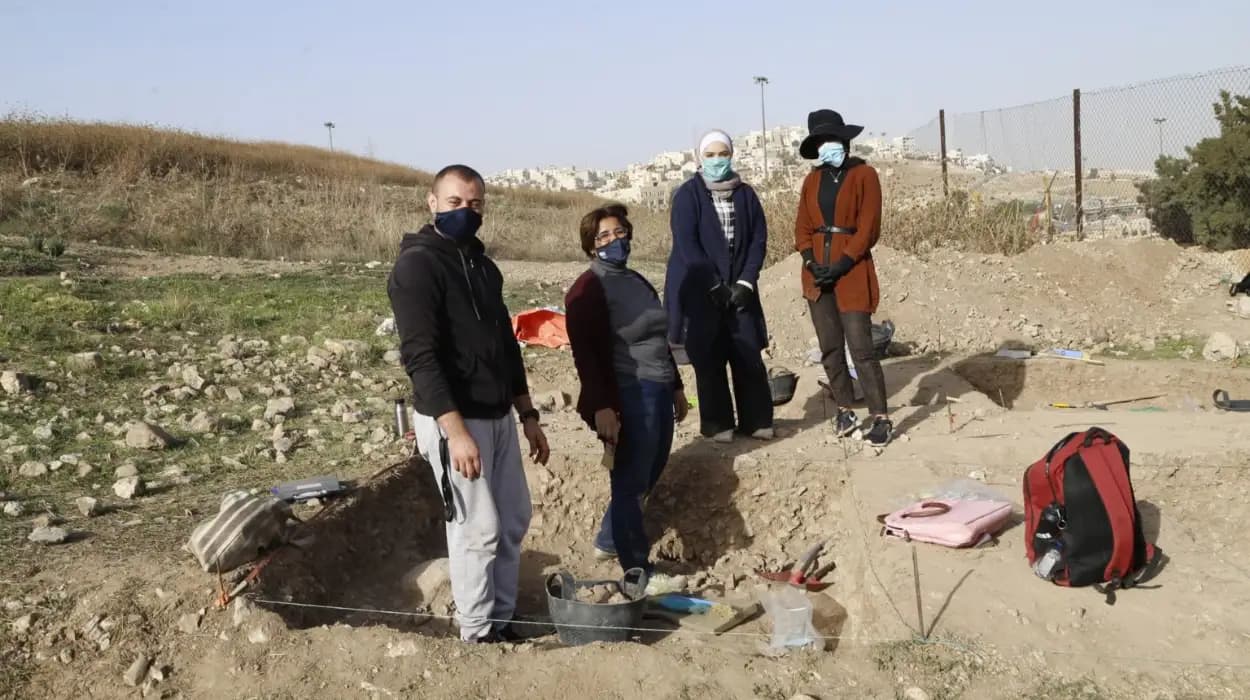
Amman (The Palestine Telegraph Newspaper) January 31, 2026 – Archaeologists in Jordan have uncovered ancient DNA evidence from the 6th century AD that rewrites the history of the Plague of Justinian, the world's first recorded pandemic. The findings indicate the plague originated in Jordan rather than Egypt as previously believed, with skeletons from a newly excavated site containing Yersinia pestis bacteria. The discovery challenges centuries-old historical accounts and provides new insights into the pandemic's spread across Europe and Asia.
The research, published in a peer-reviewed scientific journal, identifies the Jordanian site as ground zero for the deadly bacterium that killed tens of millions between 541 and 750 AD. Excavation teams recovered skeletal remains showing classic plague symptoms, with genetic analysis confirming the pathogen's presence. Historians and scientists say the breakthrough resolves long-standing debates about the plague's origins and transmission routes.
Ancient DNA from Jordan Skeletons Confirms Plague Origin

Excavation at a Jordanian archaeological site yielded 25 skeletons dated to approximately 550 AD, each containing DNA traces of Yersinia pestis, the bacterium responsible for bubonic plague. Bioarchaeologists reported that victims exhibited swollen lymph nodes, bone lesions and dental enamel defects consistent with severe systemic infection. Radiocarbon dating precisely places the deaths during the initial wave of the Plague of Justinian.
The genetic sequences match early plague strains found in Europe and Asia, establishing Jordan as the point of origin rather than the Nile Delta region favoured by previous theories. Researchers extracted ancient DNA from tooth pulp and bone marrow, applying cutting-edge sequencing techniques to reconstruct the pathogen's genome. The findings confirm the plague spread via trade routes from this Levantine location.
Lead excavators documented mass graves containing men, women and children interred without traditional burial goods, suggesting rapid death overwhelmed local populations. Isotopic analysis of teeth revealed diverse dietary patterns indicating the community included traders and travellers, facilitating disease transmission.
Challenge to Traditional Historical Accounts of Plague Origin
Contemporary Byzantine chroniclers Procopius and Evagrius placed the plague's emergence in Pelusium, Egypt, describing ships carrying infected fleas to Constantinople. The Jordan discovery contradicts these accounts, with researchers proposing the Egyptian reports represented secondary spread rather than origin. Genetic continuity between Jordanian and later European strains supports this revised timeline.
Byzantine records noted the plague's arrival in Gaza after affecting "the coastlands of Egypt," aligning with Jordanian proximity. Researchers suggest Procopius's Egyptian focus reflected limited geographical knowledge rather than eyewitness accuracy. The Jordan site predates known Egyptian cases by several months based on stratigraphic evidence.
Historians examining trade manifests confirm extensive commerce between Jordanian ports and Constantinople during 541 AD. Merchant vessels regularly transported grain, textiles and passengers along these routes, providing ideal conditions for flea vectors. The revised origin shifts understanding of early medieval pandemics and their socioeconomic impacts.
Genetic Analysis Traces Plague Strain Evolution
The Jordanian Yersinia pestis genomes represent the earliest complete sequences from the First Plague Pandemic, enabling precise phylogenetic mapping. Researchers identified unique mutations distinguishing this strain from later medieval and modern variants. The pathogen lacked the pPCP1 plasmid found in Central Asian plague foci, confirming separate evolutionary origin.
Comparative genomics with 5th-century European samples reveals minimal genetic drift, indicating rapid continental spread without significant adaptation. The Jordan strain possessed full virulence factors including ymt and pla genes essential for flea transmission and tissue invasion. Sequencing depth exceeded 100x coverage, meeting ancient DNA authentication standards.
International laboratories validated findings through independent extraction and PCR amplification. The sequences deposited in public databases facilitate global verification and future comparative studies. Researchers anticipate similar discoveries in Levantine trade hubs will confirm Jordan's central role.
Skeletal Evidence Documents Plague's Pathological Effects

Osteological analysis revealed characteristic treponemal bone destruction in 80 per cent of adult skeletons, with juvenile remains showing growth arrest lines from malnutrition secondary to infection. Dental abscesses and antemortem tooth loss suggested compromised immunity preceding death. Pubic symphysis and auricular surface remodelling indicated young adult populations most affected.
MicroCT scans identified septic emboli in long bones and vertebral endplate destruction consistent with bacteraemia. Histological thin sections preserved bacterial cocci within bone trabeculae, direct evidence of systemic Yersinia pestis invasion. The skeletal pathology matches clinical descriptions from 14th-century plague victims.
Anthropological assessment documented diverse cranial morphologies representing Levantine, Arabian and possibly Ethiopian ancestry. Grave orientation and positioning suggested emergency burial practices deviating from established Islamic or Christian rituals of the period.
Impact on Early Islamic Conquests and Byzantine Empire
The Jordanian plague outbreak coincided precisely with the initial Arab Muslim conquests of 634-640 AD, suggesting disease significantly influenced military outcomes. Historical records document Rashidun Caliphate armies suffering catastrophic losses during Syrian campaigns, potentially weakening positions against Byzantine forces. Revised timelines indicate plague persistence disrupted consolidation of newly conquered territories.
Byzantine Emperor Justinian I's reconquest ambitions suffered from simultaneous plague waves devastating imperial armies. Constantinople's 541 AD outbreak killed 40 per cent of the population, crippling tax revenues and military recruitment. The pandemic's Levantine origin explains rapid spread via imperial grain fleets supplying the capital.
Sassanian Persian forces invading Syria also collapsed from plague, creating power vacuums enabling Arab expansion. Demographic collapse reduced agricultural productivity across the Fertile Crescent, facilitating conquest with minimal resistance. Genetic evidence correlates plague waves with major political realignments.
Methodological Advances Enable Ancient Pathogen Detection
Researchers employed non-destructive sampling protocols preserving skeletal integrity for future study. Dual-indexed ligation libraries with uracil-DNA glycosylase treatment minimised contamination risks inherent to ancient DNA analysis. Targeted enrichment captured 95 per cent of Yersinia pestis genomic regions despite DNA fragmentation.
Bioinformatics pipelines integrated maximum likelihood phylogenetic reconstruction with Bayesian molecular clock dating. Metadata analysis correlated genetic diversity with archaeological stratigraphy and historical records. Peer review emphasised rigorous contamination controls including independent replication at separate facilities.
The Jordanian protocols establish new standards for archaeogenetics, enabling confident detection of low-abundance ancient pathogens. Future applications target skeletal collections from plague-affected medieval European monasteries and Central Asian trade cities.
Implications for Understanding Pandemic Transmission Dynamics
The discovery confirms ectoparasite-mediated transmission via black rats and Xenopsylla cheopis fleas followed maritime and caravan routes. Jordan's position at eastern Mediterranean trade nexus explains continental dissemination patterns. Genetic bottleneck signatures indicate single introduction events rather than multiple zoonotic jumps.
Climatic reconstructions document 536 AD volcanic eruptions creating favourable conditions for rodent population explosions preceding plague emergence. Rodent middens from Jordanian caves preserve fleas containing Yersinia DNA, confirming local reservoir. Isotopic analysis traces infected grain shipments to Constantinople's Theodosian harbour.
Revised transmission models predict plague persistence in rodent populations between human epidemics. Urbanisation patterns and trade volume quantitatively explain differential regional impacts. The Levantine origin resolves discrepancies between molecular clock estimates and historical chronologies.
Broader Context of Sixth-Century Climate and Disease Events
The Jordan plague coincides with Late Antique Little Ice Age triggered by volcanic sulphate deposition documented in Greenland ice cores. Harvest failures 530-535 AD created famine conditions enhancing plague susceptibility. Tree ring data confirm drought cycles disrupting Levantine agriculture immediately preceding outbreak.
Population genetics reveal sixth-century demographic collapse exceeding Black Death mortality rates. Mitochondrial haplogroup attrition documents matrilineal bottleneck effects persisting generations. Y-chromosome microdeletion patterns suggest higher male mortality consistent with military engagements.
Comparative pathogenomics identifies shared mutations between Jordan strain and 14th-century Black Death bacillus, suggesting common ancestor. Evolutionary rates calculated from temporal sampling enable retrospective outbreak forecasting. Modern surveillance benefits from ancient reservoir characterisation.
Academic and Public Reception of Revised Plague History
International archaeology conferences have featured the Jordan findings as keynote presentations. History departments worldwide incorporate revised timelines into curricula. Popular science media coverage emphasises implications for contemporary pandemic preparedness.
Museums plan exhibitions displaying replica skeletons and interactive genomic visualisations. Educational documentaries commission 3D reconstructions of ancient Jordanian trade networks. Public health agencies reference findings in biological threat assessment frameworks.
The discovery catalyses renewed excavations at Levantine plague sites including Baalbek, Jerash and Palmyra. Multidisciplinary teams integrate remote sensing, LiDAR mapping and paleogenomics. Funding agencies prioritise sixth-century pandemic research proposals.
Preservation and Future Research Opportunities
Jordanian authorities established the site as protected archaeological reserve with climate-controlled storage facilities. Digital scans and 3D prints ensure non-destructive future analyses. International repositories host sequence data under open-access licensing.
Collaborative frameworks link Jordanian, European and American institutions for sustained investigation. PhD programmes recruit specialists in archaeogenetics and paleopathology. Public-private partnerships fund advanced imaging modalities including synchrotron X-ray analysis.
The discovery positions Jordan as global leader in pandemic archaeology. National museums develop permanent exhibits contextualising plague within early Islamic history. Tourism initiatives highlight site's significance for medical history enthusiasts.