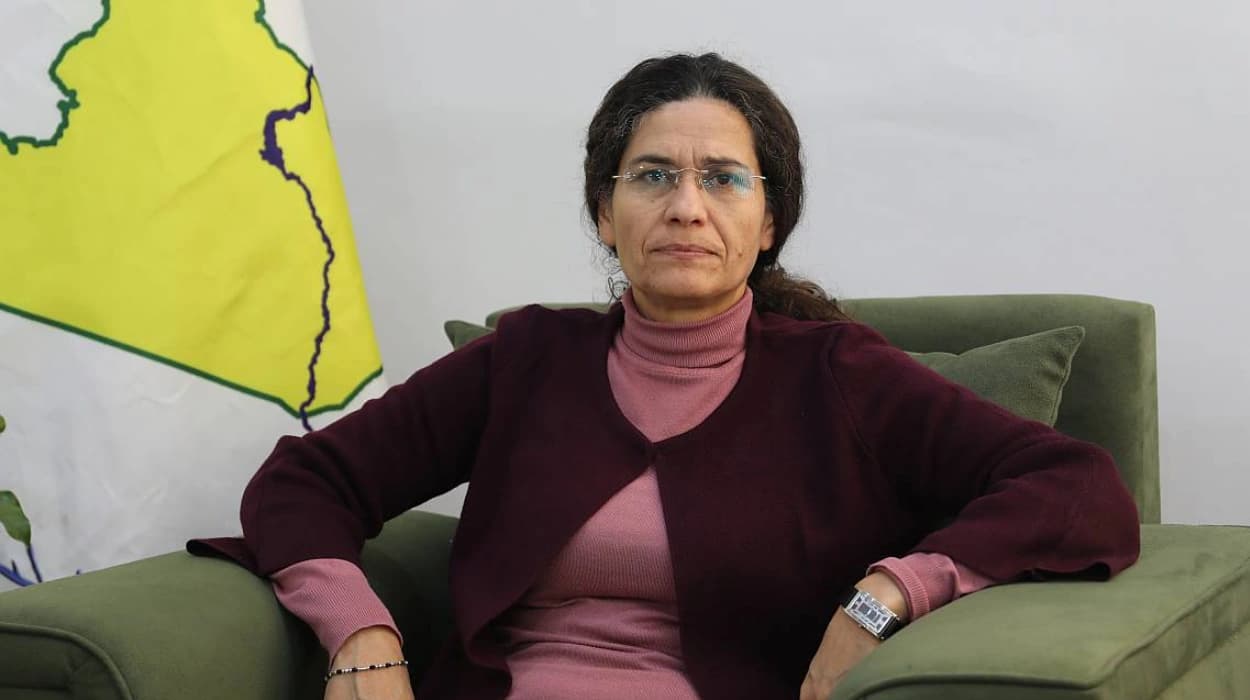
Ilham Ahmed, prominent Kurdish politician and co-president of the Executive Council of the Autonomous Administration of North and East Syria, expressed support for lifting international sanctions. She underscored the necessity that the voices of women and peoples within the region must be heard and considered in the process.
Ilham Ahmed’s Position on Sanctions and Inclusion
As reported by journalist Hawar News, Ilham Ahmed articulated the Autonomous Administration's support for the lifting of sanctions that affect the region's stability and development. However, she stressed that any such measures must come with the meaningful inclusion of women and the diverse peoples from the area, ensuring their voices contribute to political and social decisions affecting their lives.
Ilham Ahmed is a key political figure in the governance of Northern and Eastern Syria, often called Rojava, serving as co-president of the Executive Council of the Autonomous Administration. She is also a member of the Democratic Union Party and has been involved in the Kurdish nationalist movement since the 1990s. Her political career has included roles such as co-chair of the Syrian Democratic Council (SDC), the political wing of the Syrian Democratic Forces.
Advocating for Democratic Governance and Women’s Rights
According to reports by Kurdipedia and Kurdistan-focused news media, Ilham Ahmed has been a vocal advocate for a federal and decentralised Syrian state. She advocates for a political structure that guarantees the rights of all Syrian groups, including freedoms of speech, gender equality, and democratic participation.
Ahmed has been active in women’s rights initiatives, including participation in the Syrian Women’s Initiative for Peace and Democracy (SWIPD). She played a foundational role in Kongreya Star, a confederation of women’s organisations in Rojava, fostering female political empowerment.
Context of Sanctions and Regional Stability
The Autonomous Administration of North and East Syria, where Ilham Ahmed holds significant leadership, is among the most stable regions in war-torn Syria. However, economic sanctions imposed on Syria broadly have affected the region’s recovery and governance capabilities. Ahmed’s statements on lifting sanctions come amid ongoing international discussions about Syria’s humanitarian and political future.
While supporting the removal of sanctions, Ahmed emphasises that affected communities, especially women and the region's ethnic and social groups, must have their perspectives incorporated into decisions guiding the post-conflict future.
International Engagement and Political Negotiations
Ilham Ahmed has engaged in political dialogues with various national and international actors. Notably, she took part in negotiations with the Syrian government in Damascus in 2018 to discuss administrative and humanitarian services in areas administered by the SDC. Despite these talks, Ahmed has voiced frustration over the Syrian regime’s inflexibility, which she sees as an obstacle to unifying political visions for Syria.
Furthermore, following threats and military dynamics involving Turkish offensives and U.S. troop withdrawals, Ahmed travelled to Paris for talks with the French government. These talks aimed to secure continued French military cooperation and protect the autonomy of the region’s administration.
Ilham Ahmed’s Role and Recognition
Ilham Ahmed is widely recognised as a central figure in the Kurdish-led autonomous administration in Syria. Her leadership stretches across political, social, and gender rights domains. She is noted for nurturing a multiethnic coalition that supports democratic governance and stability.
Her advocacy work includes appearances in international media outlets such as The Washington Post, Foreign Policy Magazine, and op-eds in The New York Times, further amplifying her voice on democracy, peace, and women’s rights.
Looking Ahead: Emphasis on Inclusivity in Future Processes
In her recent statements, Ilham Ahmed stresses that the lifting of sanctions should not merely be a political or economic decision taken in isolation but rather a process inclusive of the affected communities. She highlights that women's participation and the representation of all peoples are vital for sustainable peace and reconstruction.
Ahmed’s position reflects the ongoing aspirations among many in the region for a democratic and inclusive future, where governance respects the rights and voices of all inhabitants, balancing political stability with social inclusion.