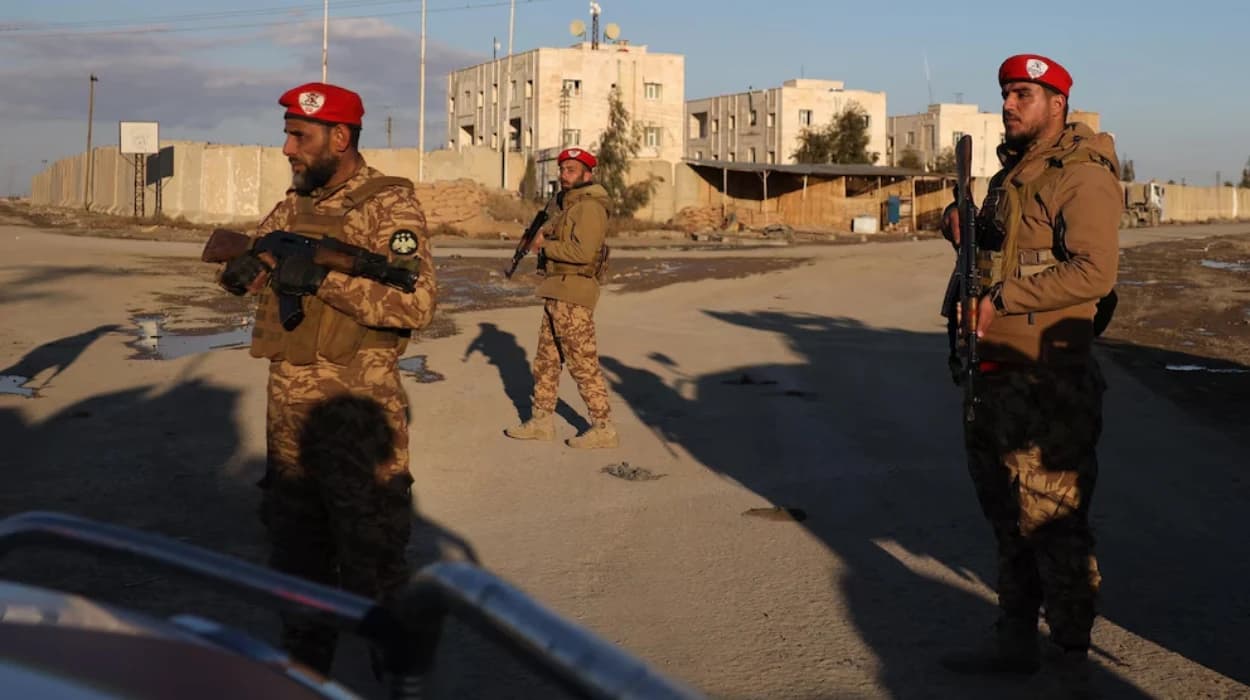
Damascus (The Palestine Telegraph Newspaper) 23 January 2026 – Syrian government forces took control of a major prison housing Islamic State group members after Kurdish-led fighters evacuated the facility amid ongoing clashes. The development occurred in northeastern Syria, where the Syrian Democratic Forces (SDF) withdrew from the site following intense fighting. No immediate reports emerged of prisoner escapes, though security concerns persisted in the region.
Syrian regime troops moved into the prison compound on 22 January 2026, hours after Kurdish-led SDF fighters pulled back from their positions. The facility, located near Hasakah in northeastern Syria, held hundreds of suspected Islamic State detainees. Syrian state media reported the takeover as a restoration of government authority in a strategic area previously under SDF control.
Local sources confirmed the SDF initiated the evacuation early that morning, citing pressure from simultaneous Turkish-backed offensives elsewhere in the region. The prison had served as a primary detention centre for foreign and local Islamic State fighters captured during prior offensives. Syrian Observatory for Human Rights monitors noted no mass breakouts during the transition, though intermittent gunfire echoed around the perimeter.
Details of the Prison Takeover Operation
Regime forces, supported by Russian air cover, advanced under minimal resistance following the SDF retreat. State television broadcast footage of soldiers raising the Syrian flag over the main gate by midday. The compound spanned several hectares, with separate wings for high-value prisoners and lower-security inmates.
SDF commanders stated the withdrawal formed part of a tactical repositioning to reinforce frontlines against Turkish proxy groups. A spokesperson for the Kurdish-led administration in northeast Syria explained the decision prioritised broader territorial defence over isolated holdings. The move left the facility unstaffed for approximately four hours before regime units arrived.
United Nations officials expressed concern over the chain-of-custody for detainees, many of whom faced charges related to Islamic State atrocities. The prison population included fighters from Europe, the Middle East, and North Africa, repatriated in small numbers over previous years. International monitors maintained limited access to the site amid the fluid security situation.
Background on Kurdish Control and Regional Conflicts
The SDF assumed control of the prison in 2019 during the final push against Islamic State territorial holdings. Kurdish forces, backed initially by US coalition troops, captured thousands of suspects in the ensuing months. The facility became a focal point for global repatriation efforts, with countries like France, Britain, and Iraq retrieving nationals under strict security protocols.
Tensions escalated after the US announced partial troop withdrawals in late 2025, reducing direct support for SDF operations. Turkish forces, viewing the Kurds as extensions of the outlawed PKK, launched cross-border incursions into SDF-held areas. These actions strained Kurdish resources, prompting prioritisation of frontline defences over rear-guard duties like prison security.
Syrian government forces capitalised on the vacuum, coordinating with Russia to reclaim ground in Deir ez-Zor and Hasakah provinces. Previous handovers occurred in Aleppo suburbs, where regime troops absorbed SDF checkpoints without major incidents. The prison takeover marked the largest single-site transfer to date.
Statements from Key Parties Involved

Credit: Borna News/Matin Ghasemi/Aksonline ATPImages/Getty Images
A Syrian military official declared the operation complete, emphasising restored sovereignty over national institutions. The statement highlighted collaboration with local tribal leaders to maintain order during the transition. Damascus pledged continued detention of all Islamic State suspects under judicial oversight.
SDF leadership described the evacuation as orderly, with non-essential personnel relocated to nearby bases. The group affirmed commitment to counter-terrorism but stressed the need for international partnership amid multiple threats. Kurdish representatives urged the regime to uphold human rights standards for detainees.
US State Department spokespersons monitored developments closely, reiterating calls for secure handling of foreign fighters. Coalition partners, including the UK and France, activated repatriation protocols for their citizens held in the facility. Turkish officials welcomed any weakening of Kurdish positions without direct comment on the prison event.
Humanitarian and Security Implications
Aid agencies reported no immediate humanitarian crises at the site, though access roads remained contested. The International Committee of the Red Cross held pre-existing agreements for detainee welfare visits, pending security clearances. Concerns lingered over potential radicalisation within overcrowded cells during the handover period.
Regional analysts noted the event underscored fragmenting alliances in Syria's eight-year civil war. Islamic State remnants exploited past prison disturbances, including a 2022 uprising that resulted in over 500 deaths. Current intelligence suggested no coordinated breakout attempts during this transition.
Local residents near Hasakah described hearing explosions prior to the SDF pullout, attributed to regime artillery targeting distant Turkish positions. No civilian casualties linked directly to the prison events surfaced in initial reports.
Historical Context of Detention Facilities
Syria hosted multiple such sites before the conflict, repurposed by various factions during hostilities. The Hasakah prison gained prominence after housing Abu Bakr al-Baghdadi associates following his 2019 death. SDF authorities implemented biometric screening and segregation measures to mitigate internal threats.
Regime control now integrated the facility into its penal system, overseen by the Ministry of Justice. Previous transfers of Islamic State suspects from Kurdish custody yielded mixed compliance with international standards, per Amnesty International documentation. Ongoing trials in Damascus courts processed detainees captured in government offensives.
International Reactions and Monitoring Efforts
European Union foreign ministers discussed the development during a 23 January virtual meeting, stressing repatriation timelines. Britain confirmed two nationals remained in custody, with extraction teams on standby. French diplomats coordinated with Damascus for access to 15 citizens.
Russia's Foreign Ministry endorsed the Syrian government's actions, framing them as anti-terrorist measures. Moscow provided logistical support, including helicopters for troop insertions. Iran-aligned militias remained neutral, focused on southern fronts.
United Nations Security Council members scheduled briefings for late January, with France and the UK proposing resolutions on detainee accountability. Observers anticipated heightened scrutiny amid stalled peace talks in Astana.
Ongoing Developments in Northeastern Syria

Credit: AP Photo/ Evan Vucci
Clashes persisted along the Turkish border, where SDF units repelled advances by Ankara-backed factions. Syrian regime reinforcements bolstered positions near the prison, deterring follow-on threats. Turkish drone activity increased overhead, monitoring ground movements.
SDF sources reported recapturing adjacent villages, stabilising flanks post-evacuation. Islamic State sleeper cells claimed responsibility for roadside bombings nearby, though unverified. Regime patrols expanded checkpoints around the facility perimeter.
No further evacuations announced as of press time. International partners pledged technical assistance for prison management upgrades. The situation evolved rapidly in Syria's contested northeast.