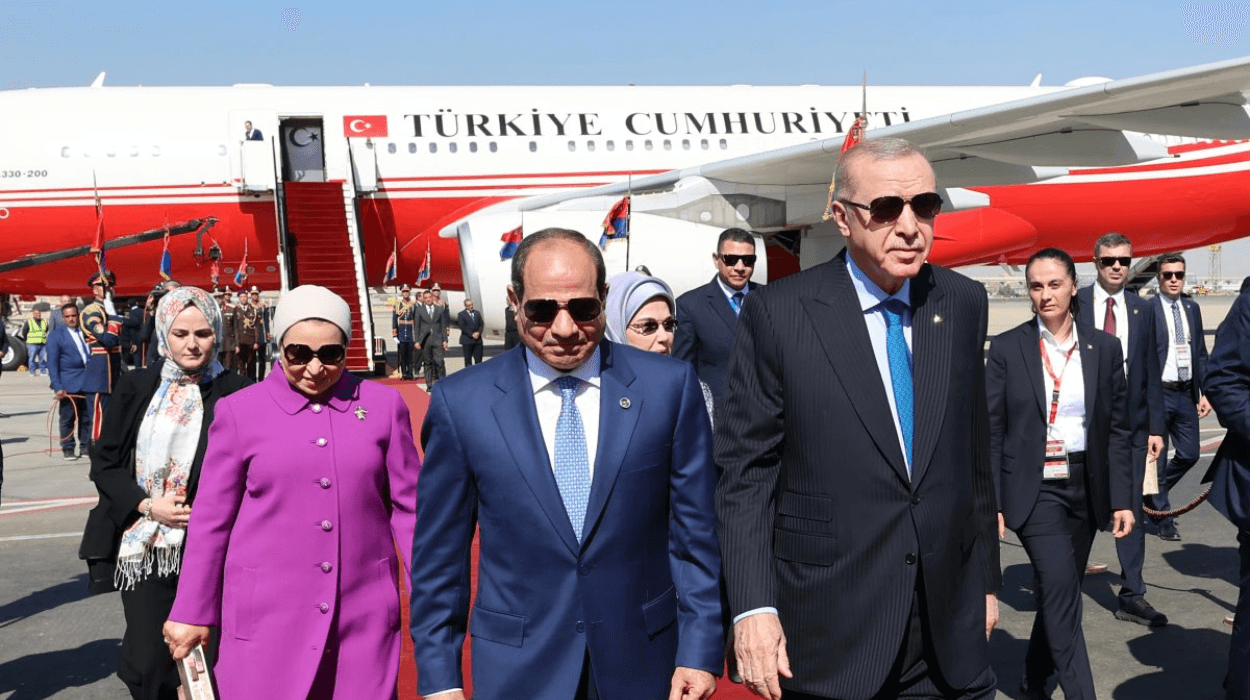
Cairo (The Palestine Telegraph Newspaper) – February 4, 2026 – Turkish President Recep Tayyip Erdogan arrived in Cairo on Wednesday after holding talks in Riyadh with Saudi Crown Prince Mohammed bin Salman. The visit, part of a regional diplomatic push, has drawn attention from Israeli officials monitoring Turkey-Saudi-Egypt ties. Developments include discussions on Gaza ceasefire efforts and economic cooperation, with no official statements confirming outcomes yet.
Turkish President Recep Tayyip Erdogan touched down at Cairo International Airport on Wednesday afternoon, marking a significant stop in his Middle East tour following high-level meetings in Riyadh. Egyptian state media reported the arrival, noting a warm reception by senior officials including Foreign Minister Badr Abdelatty. The trip comes amid ongoing regional tensions, particularly surrounding the Gaza conflict.
Journalist Hakan Copur provided an eyewitness account of the airport welcome. [Hakan Copur] said in X post,
“President Erdogan arrived in Cairo, where he was welcomed at the airport by Egyptian President Sisi. Egypt marks Erdogan’s second stop after Saudi Arabia amid growing uncertainty over U.S.–Iran tensions.”
Erdogan's delegation includes key ministers and advisors, focusing on bilateral relations strained in recent years but showing signs of thaw. In Riyadh earlier this week, Erdogan met Saudi Crown Prince Mohammed bin Salman for over three hours, covering topics from energy deals to humanitarian aid for Gaza. Saudi state news agency SPA confirmed the talks emphasised unity against regional instability.
Details of Riyadh Discussions Preceding Cairo Visit
The Riyadh summit addressed shared concerns over the Israel-Hamas war, now in its third year. Sources from the Turkish presidency stated that Erdogan urged Saudi Arabia to leverage its influence in Washington for a sustainable truce in Gaza. Crown Prince Salman reportedly reaffirmed Saudi commitment to reconstruction efforts post-ceasefire, pledging $5 billion in aid conditional on progress.
A US-based reporter highlighted specifics from the Riyadh meeting. [Melissa Weiss] said in X post,
“As concerns mount over Saudi Arabia's shift away from moderation, MBS and Erdogan met yesterday in Riyadh, where they inked an agreement condemning Israel's recognition of Somaliland and calling for an immediate Israeli withdrawal from Syria, @matthewashea_ reports.”
Egyptian President Abdel Fattah al-Sisi is scheduled to host Erdogan for private dinner talks tonight, according to Al-Ahram newspaper. Agenda items include reviving the 1979 Egypt-Israel peace treaty frameworks amid Sinai security issues. No joint press conference is planned, but a readout is expected from both sides by Thursday.
Israeli media, including Ynet News, highlighted the timing of Erdogan's tour just days after Turkey expelled an Israeli diplomat over Gaza comments. Jerusalem officials expressed vigilance, noting Turkey's vocal criticism of Israeli operations in Rafah. Prime Minister Benjamin Netanyahu's office declined immediate comment but scheduled an emergency security cabinet meeting.
Historical Context of Turkey-Egypt-Saudi Relations
Relations between Ankara and Cairo normalised in 2023 after a decade of frosty ties following the 2013 ousting of Egypt's Muslim Brotherhood president Mohamed Morsi. Erdogan, a Brotherhood supporter, had severed ties, but economic pressures and mutual interest in countering Iranian influence prompted reconciliation. Trade volume reached $15 billion last year, per Turkish trade ministry figures.
Saudi Arabia played mediator in the thaw, hosting normalisation talks in 2022. The trio's alignment strengthened at the 2024 Jeddah Summit, where leaders condemned Houthi attacks in the Red Sea. This week's Riyadh-Cairo axis underscores efforts to present a united Sunni front, as reported by Reuters.
Egypt's role as Gaza mediator adds weight to the visit. Cairo brokered the November 2024 hostage release deal and continues shuttle diplomacy. Erdogan praised Sisi's efforts in a pre-trip statement, calling for "immediate humanitarian corridors".
Israeli Reactions and Regional Security Implications
Israel's concerns stem from Erdogan's repeated vows to isolate it internationally. In a January speech, he likened Israeli actions to "genocide," prompting trade halts on Israeli goods. Israeli Ambassador to the UN Gilad Erdan accused Turkey of "appeasing Hamas" during a Security Council session.

Defence Minister Yoav Gallant ordered increased surveillance along the Syria border, citing potential Turkish arms flows to Hezbollah via Iraq routes. Channel 12 News aired reports of Mossad briefings warning of a "new anti-Israel bloc".
No direct communications occurred between Jerusalem and Ankara ahead of the visit, per Haaretz. Egypt assured Israel of de-escalation focus during a hotline call between intelligence chiefs.
Economic Dimensions of the Diplomatic Tour
Beyond politics, the tour eyes multimillion-dollar deals. Turkey seeks Egyptian liquefied natural gas imports to offset sanctions on Russian supplies. A memorandum for a $10 billion Black Sea gas pipeline was floated in Riyadh, with Cairo as potential hub.
Saudi Arabia committed to investing in Turkish drone technology, building on Bayraktar TB2 exports used in Yemen operations. Egyptian firms expressed interest in Turkish nuclear plant construction at El-Dabaa, delayed by funding woes.
The World Bank estimates Gaza reconstruction at $50 billion, with Turkey pledging $1 billion, Saudi $3 billion, and Egypt logistical support. Joint venture announcements could follow summits.
Broader Middle East Diplomatic Landscape
The visits align with US President Donald Trump's February push for Abraham Accords expansion. Riyadh signalled openness to normalisation with Israel if Palestinian statehood advances, per Asharq Al-Awsat leaks. Erdogan opposes such deals without full sovereignty recognition.

Qatar and UAE envoys attended Riyadh sidelines, indicating Gulf coordination. Iran's foreign ministry criticised the meetings as "Zionist encirclement," vowing proxy retaliation.
UN Secretary-General Antonio Guterres welcomed the diplomacy, urging all parties to prioritise aid convoys stalled at Rafah crossing.