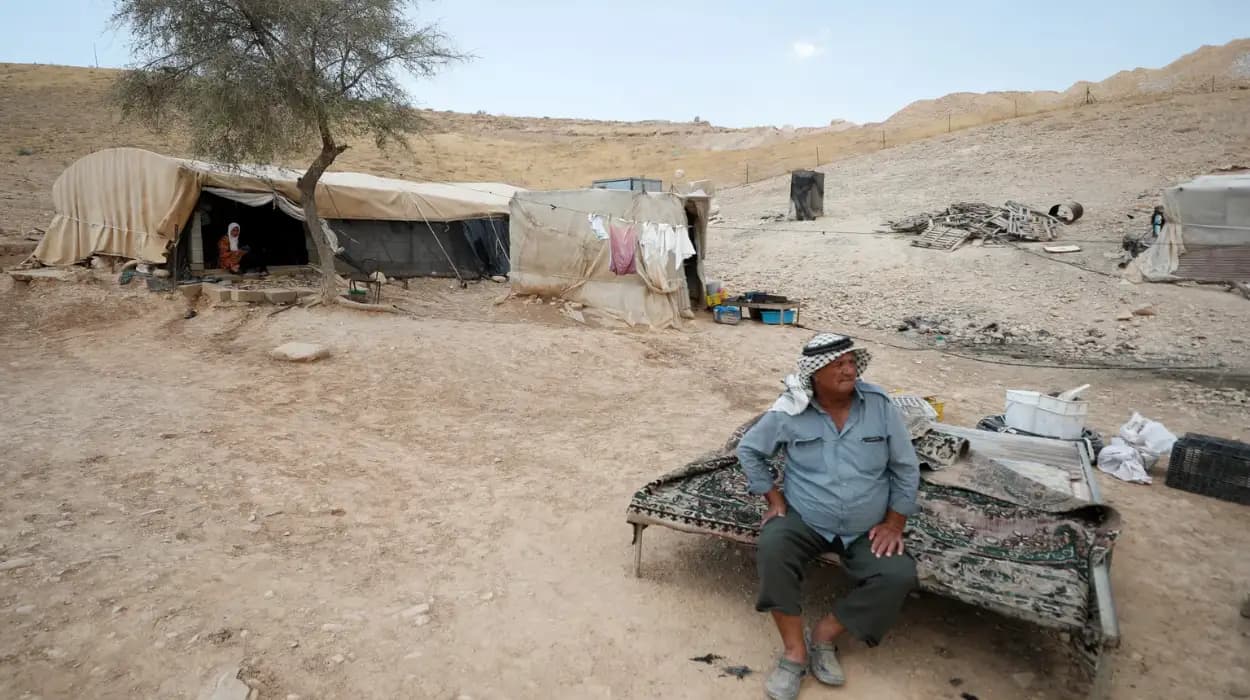
Jerusalem (Brussels Morning Newspaper) 22 January 2026 – Settler violence in the occupied West Bank has emptied nearly three-quarters of the Palestinian Bedouin village of Ras Ein al-Auja, forcing hundreds to flee. Residents who remain report deliberate efforts to push them from their homes, leaving them with nowhere else to go. Israeli authorities have not intervened amid ongoing tensions in the region.
Israeli settler violence has led to the displacement of nearly three-quarters of the residents from Ras Ein al-Auja, recognised as the largest Palestinian Bedouin village in the occupied West Bank. Hundreds of families have fled the area following repeated attacks, with the remaining population facing continued pressure to leave.
Local reports indicate that the violence has intensified over recent months, prompting urgent calls for intervention.
The village, located near the northern Dead Sea in Area C under full Israeli administrative control, has housed around 1,200 Bedouin residents prior to the latest escalation. Structures in the community have been targeted, contributing to the exodus. Palestinian officials documented the departure of approximately 900 individuals, leaving fewer than 300 in place.
Details of Recent Settler Violence
Settler attacks on Ras Ein al-Auja began escalating in late 2025, with residents reporting nightly raids involving stone-throwing, arson, and threats. Videos circulated by locals show masked settlers cutting water pipes and destroying solar panels essential for the community's survival. One resident stated, "They come every night, burning tents and demanding we leave our land," as quoted in field reports from humanitarian organisations.
The violence peaked in early January 2026, when settlers reportedly set fire to over 20 tents and livestock enclosures, displacing 150 families in a single week. Israeli human rights group B'Tselem recorded 45 incidents since October 2025, including physical assaults on villagers. No arrests have been made by Israeli forces, who maintain a presence nearby but have not dispersed the attackers.
Palestinian Bedouin families, many originally from the Negev region, have resided in Ras Ein al-Auja for decades, relying on pastoral livelihoods. The loss of grazing lands due to settlement expansion has compounded vulnerabilities, with demolitions of unauthorised structures occurring periodically.
Impact on Displaced Residents
 Credit: aljazeera.com
The forced displacement has left hundreds without shelter, with many relocating to nearby towns like Jericho or Ein al-Sultan refugee camp. Humanitarian aid groups report acute shortages of water and food among the evacuees, who arrived with minimal possessions. UNRWA provided emergency tents to 200 families, but distribution challenges persist due to restricted access in Area C.
Remaining residents express determination to stay despite ongoing threats. A village elder told reporters, "This is our land; we have nowhere else to go," highlighting the lack of alternative relocation sites approved by authorities. Children in the community face disrupted schooling, with enrolment dropping by 70 per cent as families flee.
Economic fallout includes the loss of over 5,000 sheep and goats, key to the Bedouins' sustenance. Compensation claims submitted to Israeli courts have yielded no responses, per legal aid records.
Historical Context of Ras Ein al-Auja
Ras Ein al-Auja was established post-1948 by Bedouins displaced during the Nakba, growing into the largest such community in the West Bank. Its strategic location near Route 90 has attracted settlement activity since the 1980s. Nearby outposts like Chashmonaim and Ma'ale Mikhmas have expanded, encroaching on village lands designated for military zones.
Israeli government plans, approved in 2024, allocate parts of the area for new settlements, prompting preemptive demolitions. Over 50 structures in Ras Ein al-Auja were razed in 2025 alone, according to Peace Now monitoring. The village lacks basic infrastructure, with residents denied connection to national electricity and water grids.
Responses from Authorities and Organisations
 Credit: Lisi Niesner/Reuters
The Plestinian Authority condemned the violence, with governor of Jericho Ismail Ghawsha calling for international protection. PA President Mahmoud Abbas addressed the issue in a 20 January statement, labelling it "systematic ethnic cleansing." No official response has come from Israeli Prime Minister Benjamin Netanyahu's office.
The UN Office for the Coordination of Humanitarian Affairs (OCHA) issued a report on 18 January detailing the displacement, urging Israel to halt settler vigilantism. OCHA spokesperson stated,
"The safety of civilians must be ensured regardless of status."
European Union foreign ministers discussed the West Bank situation at their 21 January meeting, expressing concern over rising incidents.
Israeli Defence Minister Israel Katz deployed additional troops to the Jordan Valley but focused on "preventing terrorism," without mentioning settler actions. Human Rights Watch documented similar patterns in 15 Bedouin sites, attributing over 1,200 displacements in 2025 to settler pressure.
Patterns of Settler Activity in the West Bank
Settler violence has surged since October 2023, with UN data recording 1,860 attacks in 2025, the highest annual figure. Ras Ein al-Auja fits a broader trend targeting herder communities to clear land for annexation. Groups like Regavim advocate for evictions, claiming Bedouin structures are illegal.
Incidents often coincide with olive harvest seasons or Sabbath evenings, minimising witness presence. Israeli police investigations rarely lead to prosecutions, with a 3 per cent indictment rate per Yesh Din statistics. The international community, including the UK and France, summoned Israeli ambassadors over the issue in December 2025.
Broader Regional Developments
The displacement occurs amid stalled peace talks and post-Gaza ceasefire fragility. US-mediated discussions in 2025 addressed West Bank stability but yielded no settlement freeze. Quartet representatives met in Brussels on 19 January, prioritising de-escalation.
Local NGOs report 40,000 Palestinians displaced across the West Bank since 2022 due to demolitions and violence. Bedouin vulnerability stems from their unrecognised status, barring building permits. Jordan Valley communities, numbering 15, face parallel pressures from military orders.
Humanitarian and Legal Challenges
 Credit: Omar al-Qattaa/AFP
Aid access to Ras Ein al-Auja remains intermittent, with Israeli checkpoints blocking convoys. Norwegian Refugee Council teams delivered supplies on 20 January, aiding 100 families. Legal challenges under Oslo Accords cite violations of Area C protections, filed by Al-Haq with the ICC.
Palestinian negotiators demand inclusion in any future land-use plans, absent from current proposals. Israeli Civil Administration surveys indicate potential relocation to a centralised site near Jericho, rejected by residents as inadequate.