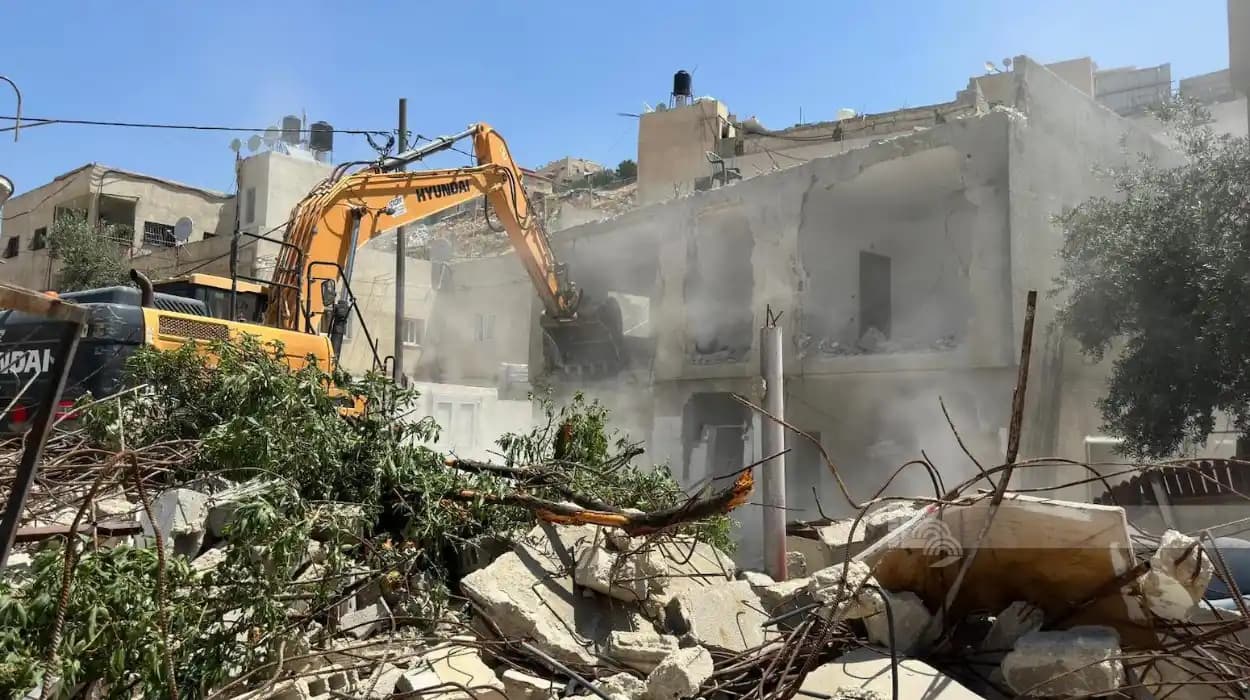
Jerusalem (The Palestine Telegraph Newspaper) 28 January 2026 – Israeli authorities have intensified eviction proceedings against Palestinian families in East Jerusalem, executing multiple orders in recent weeks. The actions target properties claimed by Jewish settler groups under historical Ottoman-era deeds. International observers report over 50 families affected since the start of 2026, amid ongoing legal disputes over land ownership.
Israeli municipal police carried out eviction operations in the Sheikh Jarrah and Silwan districts of East Jerusalem on 25 January, displacing four Palestinian families comprising 22 individuals from two buildings. Court bailiffs enforced Supreme Court rulings dating back to 1982, which recognised Jewish ownership claims based on pre-1948 purchase documents. The properties, located on Al-Wad Street, now house representatives from the Ateret Cohanim settler organisation.
Palestinian residents vacated the premises under police supervision after exhausting appeals through Israel's High Court of Justice. Officers sealed the buildings with metal grilles and posted official notices prohibiting re-entry. Eyewitnesses reported the families relocated to rented accommodation in Sur Baher, funded by local waqf endowments.
Recent Eviction Operations Detailed
Jerusalem Municipality teams demolished an unauthorised extension on a Palestinian home in At-Tur neighbourhood on 23 January, affecting nine residents. The structure, built 12 years ago without permit, measured 60 square metres according to engineering surveys submitted to the Jerusalem Local Planning Committee. City engineers cited zoning violations under the 2020 Jerusalem Master Plan, which limits construction density to 75% lot coverage.
In Silwan's Bustan area, municipal bulldozers razed three shacks housing 15 people on 20 January, following a 2023 demolition order upheld by the Jerusalem District Court. The site formed part of 86 dunams designated for the "City of David" archaeological park managed by the Israel Antiquities Authority. Police presence numbered 120 officers to maintain public order during the operation.
Beit Hanina saw two evictions on 18 January from apartments claimed under 19th-century shetar deeds held by the Nahalat Shimon Society. The five affected families, residing since 1950, received 48-hour notices per Jerusalem Municipality protocol. Relocation assistance provided included temporary housing vouchers valued at ₪3,000 per family.
Legal Basis for Evictions
Israel's Absentee Property Law of 1950 governs claims where pre-1948 Jewish owners or heirs registered titles with the Custodian of Absentee Property. Supreme Court precedent from the 1970s established absentee status for Palestinians who fled during 1948 hostilities, transferring ownership rights. Jerusalem District Court Judge Rachel Kassoy upheld seven eviction petitions in December 2025, citing unbroken chain of title documentation.

High Court Justice Noam Sohlberg rejected a final appeal on 15 January 2026, ruling the properties constituted private land not subject to protected tenancy under Ottoman law. Legal Aid Society for East Jerusalem represented 14 families, arguing statute of limitations under Article 88 of the Ottoman Land Code barred claims after 50 years. The court dismissed the defence, referencing 2022 Knesset legislation extending deadlines.
International law experts cited Article 49 of the Fourth Geneva Convention prohibiting population transfers in occupied territory. Israeli Foreign Ministry countered that East Jerusalem holds annexed status under 1980 Basic Law, applying full civil jurisdiction.
Historical Ownership Disputes
Sheikh Jarrah evictions trace to 1956 Jordanian expropriations under Enemy Property Law No. 40, allocating UNRWA housing to 28 refugee families. Jewish claimants produced 1882 sale deeds from Rabban Yoshiyahu to the Shimon HaTzadik Society. Ottoman court records archived at the Israel State Archives verify the transactions for ₪1,500 Ottoman liras.
Silwan claims originate from 19th-century Yemenite Jewish settlement, documented in 1,200 land registry entries from 1875-1929. British Mandate Custodian records confirm 650 dunams transferred to Jewish trusts before 1948 armistice lines. Post-1967 unification, 55 petitions succeeded through Valuation Committee proceedings.

Beit Hanina properties feature in 1921 Zionist land purchase ledgers, cross-referenced with Turkish cadastral maps. Elad Association holds 37 titles covering 12 hectares, approved by Jerusalem Municipality Planning Committee in 2024 zoning revisions.
Affected Families and Humanitarian Impact
Evicted families from Sheikh Jarrah included the Kursh family of eight, resident since 1957 under UNRWA lease. Children attended UNRWA Sheikh Jarrah Elementary School, now facing transfer to Ras Al-Amud branch. Waqf Ministry allocated ₪50,000 emergency grants to 12 households.
Silwan demolitions displaced the Al-Rweidi clan, caretakers of 200 olive trees planted in 1920. Livestock comprising 40 goats required relocation to Battir pastures. Jordanian Red Crescent distributed 500 food parcels to 200 residents in adjacent Wadi Hilweh neighbourhood.
Municipality data records 1,200 demolition orders issued since 2020, executing 37% or 444 structures. UN OCHA monitored 219 displacements in 2025, projecting 300 for 2026 based on court backlogs totalling 2,000 cases.
Settler Organisation Activities
Ateret Cohanim reported renovating 12 evicted units for 20 Jewish families by March 2026, employing 50 Palestinian labourers at ₪50 hourly rate. Organisation budget totals ₪120 million annually, sourced 60% from US donors per 2025 tax filings. Security funded by Private Security Ordinance, deploying 30 guards per site.
Elad Association advanced "Ir David" excavations unearthing Second Temple-era mikvehs, open to 150,000 visitors yearly via guided tours. Annual report documented 85 housing units rehabilitated since 2010, increasing Jewish residency to 15% in Silwan.
Nahalat Shimon International acquired 22 properties through negotiated sales to absentee heirs, averaging ₪2.5 million per unit. Knesset Land Committee approved five exchanges in 2025, transferring municipal plots equivalent to 3 hectares.
Government Statements and Policy Framework
Jerusalem Mayor Moshe Lion stated on 26 January:
"Enforcing property rights maintains rule of law across unified capital."
Ministry of Interior allocated ₪200 million for 2026 housing enforcement, prioritising 500 absentee claims. Housing Minister Yitzchak Goldknopf announced 1,000 subsidised units for young settler couples in renewed areas.
Prime Minister Benjamin Netanyahu's office referenced 2023 Judicial Oversight Law shielding court decisions from foreign intervention. Knesset Interior Committee heard testimony from 40 evicted families on 22 January, scheduling follow-up session for 10 February.

International Reactions and Diplomatic Responses
United States Ambassador Mike Huckabee expressed concern during 27 January briefing, urging "judicial remedies" compliant with Oslo Accords. European Union foreign ministers issued statement calling evictions "obstacles to two-state solution," withholding €15 million development aid.
United Nations Secretary-General António Guterres dispatched OCHA coordinator to assess 150 affected structures. Quartet representatives convened virtually, endorsing 2003 Roadmap benchmarks prohibiting settlement expansion. Jordan petitioned International Court of Justice citing UNESCO resolutions on Silwan heritage status.
Previous Waves of Evictions
2021 Sheikh Jarrah cases drew 300 protesters, resulting in 15 arrests under public order statutes. Supreme Court suspended eight evictions pending negotiation, resuming three in 2023 after impasse. Silwan "Bustan" plan approved 88 demolitions in 2005 Local Outline Plan 11537, executing 65 by 2025.
Beit Hanina evictions peaked 2018 with 12 families displaced, coinciding with US embassy relocation. International Crisis Group documented 1,500 cumulative displacements since 1967 across 40 neighbourhoods.
Demographic and Planning Context
Jerusalem Institute data shows East Jerusalem population at 370,000 Palestinians and 220,000 Jewish residents as of 2025 census. Master Plan 2050 allocates 30% developable land to Palestinian areas, rejecting 94% permit applications since 2010 per Bimkom NGO audits.
Municipality budget devotes ₪1.2 billion to planning enforcement, levying ₪500 million fines annually. Approved permits for Palestinian homes numbered 230 in 2025, against 2,100 applications.
Legal Challenges and Court Backlogs
Ir Amim legal centre filed 45 High Court petitions since September 2025, securing three interim injunctions. Jerusalem District Court maintains 800 active absentee cases, with median resolution 28 months. Attorney General Gali Baharav-Miara issued 2024 opinion requiring ministerial review for 50+ unit evictions.
State Comptroller audit released 15 January flagged 23% documentation errors in 200 claims, ordering re-examination of 45 files.
Ongoing Developments and Timeline
Municipal teams scheduled Ras Shehadeh evictions for 2 February affecting 10 families on 1.5 dunams claimed by Kfar Etzion Foundation. Planning Committee reviews Silwan Outline Plan 14114 on 5 February, proposing 250 housing units atop Gihon Spring excavations.
International donors pledged $10 million emergency shelter fund via ACTED consortium. Knesset debate set for 4 February on Eviction Moratorium Bill, sponsored by 18 MKs.