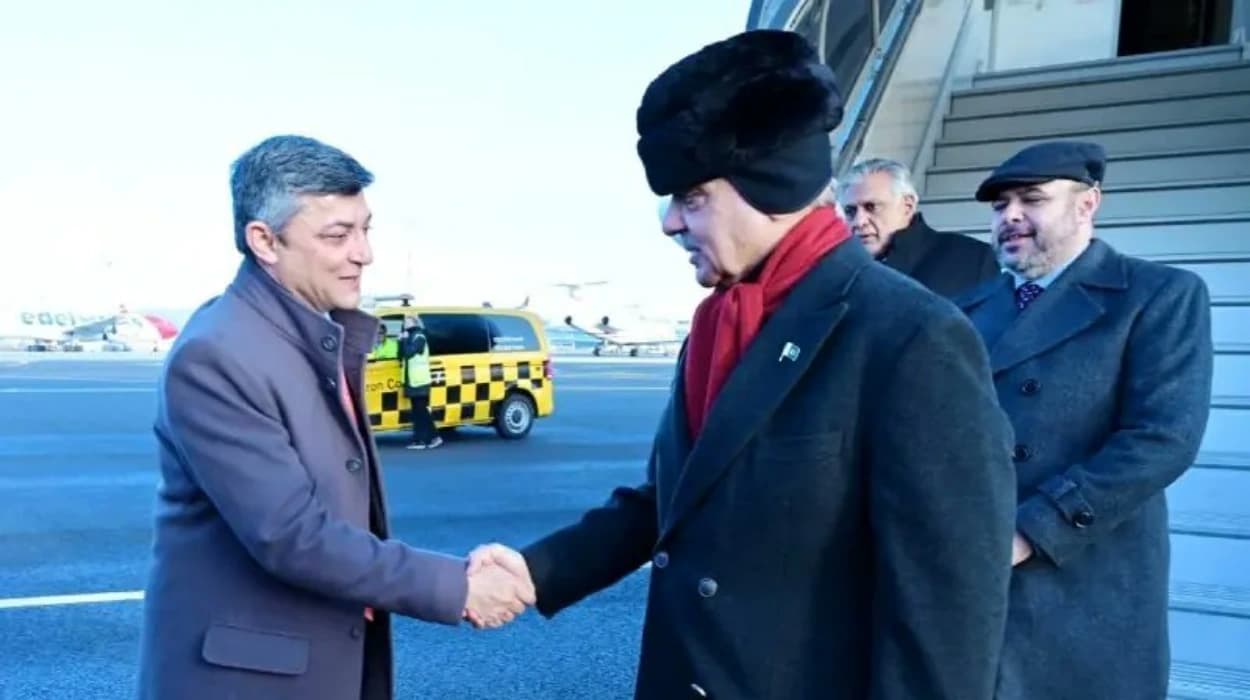
Davos (Brussels Morning Newspaper) – 21 January 2026 – Pakistani Prime Minister Shehbaz Sharif has commenced his World Economic Forum engagements in Davos by holding a meeting with Palestinian Prime Minister Mohammad Shtayyeh. The leaders discussed bilateral cooperation, regional stability and support for Palestinian statehood aspirations. The encounter forms part of Sharif’s packed schedule at the annual gathering of global leaders, focusing on economic recovery, climate action and diplomatic outreach.
Prime Minister Shehbaz Sharif arrived in Davos on Monday for the World Economic Forum’s annual meeting, where heads of government, business executives and international organisation leaders convene to address pressing global challenges. His first formal bilateral engagement involved a discussion with Palestinian Prime Minister Mohammad Shtayyeh on the sidelines of the forum’s opening sessions. The meeting covered topics such as economic development in the Palestinian territories, humanitarian assistance and Pakistan’s longstanding support for a two-state solution to the Israeli-Palestinian conflict.
Shehbaz Sharif’s Davos schedule emphasises diplomatic priorities

Credit: AAMIR QURESHI/AFP/Getty Images
Sharif’s office released a readout stating that the leaders exchanged views on the current situation in the Middle East and explored avenues for enhanced Pakistan-Palestinian collaboration. Prime Minister Shtayyeh expressed appreciation for Pakistan’s consistent diplomatic backing at the United Nations and other international forums. The two sides agreed to maintain regular contact and coordinate positions ahead of upcoming multilateral meetings.
The Pakistani delegation highlighted Sharif’s intention to use the Davos platform for a series of bilateral meetings with counterparts from Europe, the Middle East and Asia. Additional engagements include discussions with European Commission President Ursula von der Leyen on trade relations and climate finance, as well as talks with Saudi Crown Prince Mohammed bin Salman on regional security cooperation. Sharif is also scheduled to participate in panel discussions on sustainable development and digital transformation.
Context of Pakistan’s diplomatic presence at World Economic Forum
Pakistan has maintained a regular presence at the World Economic Forum since its inception, with prime ministers attending periodically to promote investment opportunities and outline national development strategies. Shehbaz Sharif’s participation follows his attendance at previous forums, where he focused on attracting foreign direct investment for infrastructure projects and export diversification. This year’s agenda aligns with Pakistan’s economic stabilisation efforts under an International Monetary Fund programme.
The forum provides a venue for informal diplomacy alongside formal sessions on global economic outlook and geopolitical risks. Sharif’s team arranged over a dozen bilateral meetings, reflecting Pakistan’s priorities in economic diplomacy, energy security and counter-terrorism cooperation. Meetings with counterparts from the United Arab Emirates and Turkey are also confirmed, covering trade agreements and defence collaboration.
Focus areas of Sharif-Shtayyeh bilateral discussion
 Credit: PMO
During their meeting, the two prime ministers addressed immediate humanitarian needs in Gaza and the West Bank, including medical supplies and food assistance. Pakistan has provided emergency aid shipments through Jordan and Egypt in recent months, coordinated with United Nations agencies. Prime Minister Sharif reaffirmed Pakistan’s commitment to Palestinian self-determination and called for resumed peace negotiations based on pre-1967 borders.
Prime Minister Shtayyeh outlined challenges facing the Palestinian Authority, including fiscal constraints and settlement expansion. The Palestinian side welcomed Pakistan’s advocacy for membership in international bodies and support during recent United Nations General Assembly sessions. Both leaders emphasised the importance of unity among Muslim-majority countries in addressing the Palestinian question.
Pakistan’s longstanding policy on Palestinian issue
Pakistan’s foreign policy has consistently supported Palestinian statehood since the country’s founding in 1947. Successive governments have maintained non-recognition of Israel and advocated for a sovereign Palestinian state with East Jerusalem as its capital. This position was reiterated by Sharif during his 2024 address to the United Nations General Assembly, where he called for an immediate ceasefire in Gaza.
Diplomatic engagements with Palestinian leadership form a regular component of Pakistani prime ministerial travel. Previous meetings between Sharif and Shtayyeh occurred on the margins of the United Nations General Assembly and Organisation of Islamic Cooperation summits. These discussions typically cover budgetary support, scholarship programmes for Palestinian students and technical assistance in public administration.
World Economic Forum 2026 key themes and Pakistani participation
The 2026 Davos meeting centres on themes of rebuilding trust, advancing equitable growth and addressing fragmentation in global governance. Over 2,500 participants from 120 countries attend, including 50 heads of state and government. Pakistan’s delegation includes Finance Minister Muhammad Aurangzeb and Foreign Minister Ishaq Dar, who are engaging on debt restructuring and climate adaptation financing.
Sharif is set to deliver a special address on Pakistan’s economic reforms and flood recovery efforts following the 2022 disasters. The forum features sessions on artificial intelligence governance, energy transitions and supply chain resilience, areas where Pakistan seeks international partnerships. Bilateral meetings also target investment in renewable energy projects and textile sector modernisation.
Regional dynamics influencing Pakistan’s Davos diplomacy
Sharif’s Davos engagements occur amid evolving regional relationships, including strengthened ties with Saudi Arabia and the United Arab Emirates through investment frameworks. Discussions with Gulf Cooperation Council leaders focus on rolling over deposit facilities and joint ventures in agriculture and minerals. The Palestinian meeting underscores continuity in Pakistan’s principled stance on core foreign policy issues.
Relations with European partners emphasise compliance with Financial Action Task Force standards and green investment criteria. Meetings with German Chancellor Olaf Scholz and French President Emmanuel Macron address skilled labour mobility and defence equipment procurement. These engagements build on the Strategic Dialogue framework established during Sharif’s 2024 European tour.
Broader Middle East component of Sharif’s itinerary
Beyond the Palestinian meeting, Sharif’s Middle East-focused diplomacy includes sessions with Jordan’s King Abdullah II and Qatari Emir Sheikh Tamim bin Hamad Al Thani. Topics cover mediation efforts in regional conflicts and pilgrimage facilitation arrangements. Pakistan maintains observer status in the Organisation of Islamic Cooperation, where coordination with Palestinian representatives occurs regularly.
The prime minister’s office indicated that discussions with Shtayyeh also touched on upcoming Arab League summits and coordination for the March 2026 Organisation of Islamic Cooperation Council of Foreign Ministers meeting. Pakistan chairs the bloc’s Economic Cooperation Committee, providing additional platforms for Palestine-focused initiatives.
Economic dimensions of Pakistan’s World Economic Forum participation
Davos serves as a marketplace for investment promotion, with Pakistan showcasing opportunities in information technology, mining and logistics. The Board of Investment organised a dedicated pavilion highlighting special economic zones and tax incentives. Sharif’s meetings with global chief executives from technology and energy sectors aim to secure commitments for joint ventures.
Finance Minister Aurangzeb is leading discussions on climate finance, seeking grants and concessional loans for adaptation projects. Pakistan’s vulnerability to extreme weather events positions the country as a priority for multilateral development banks attending the forum. Special envoy for climate change Romina Khurshid Alam participates in sessions on loss and damage mechanisms.
Follow-up mechanisms from Sharif’s bilateral engagements
 Credit: PPI
Readouts from Sharif’s office confirm that memorandums of understanding on technical cooperation will follow several Davos meetings. The Palestinian discussion identified priority areas for capacity-building in customs administration and vocational training. Follow-up coordination will occur through respective foreign ministries and Pakistani embassies in the region.
Pakistan’s diplomatic calendar post-Davos includes participation in the Munich Security Conference and G20 development working group meetings. The prime minister’s engagements lay groundwork for these forums, particularly on counter-terrorism financing and regional connectivity initiatives. Official briefings will provide updates on outcomes as agreements are formalised.