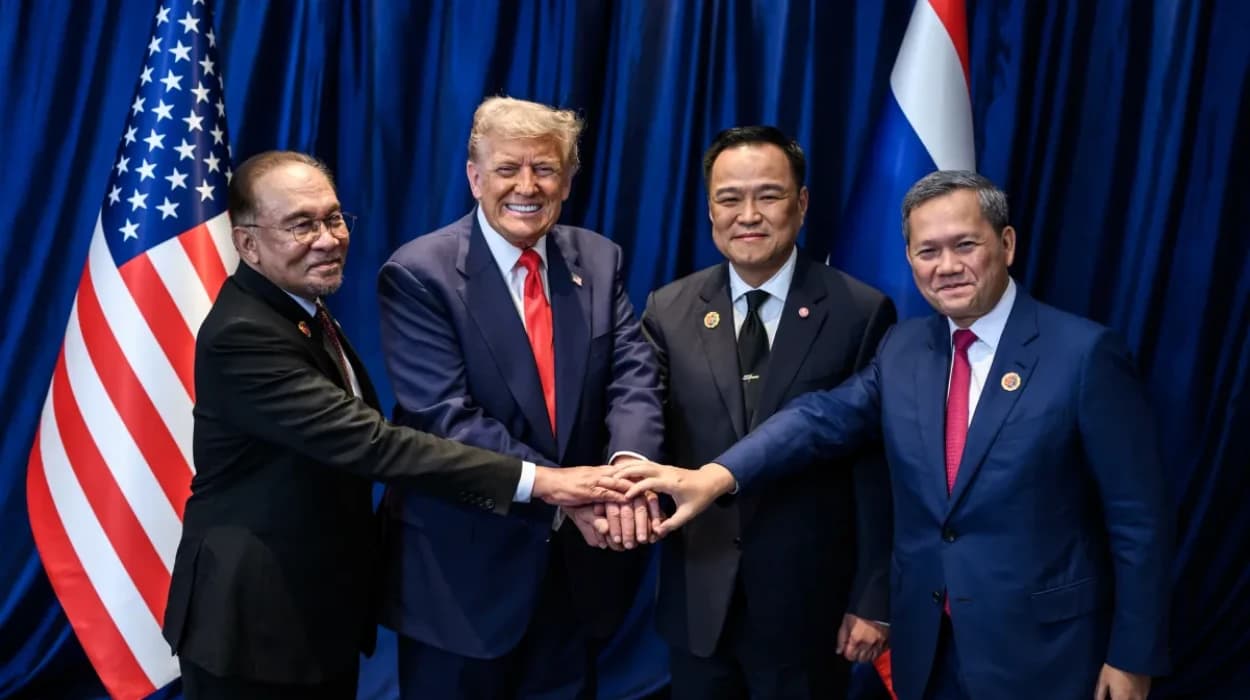
During his two-day visit to Malaysia for the ASEAN Summit, President Donald Trump brokered a peace deal between Cambodia and Thailand and signed trade agreements with several Southeast Asian nations. However, despite these achievements, deep concerns over US tariffs and erratic policies have led the region to diversify away from reliance on Washington, diminishing its influence in Southeast Asia.
During a high-profile two-day visit to Kuala Lumpur for the Association of Southeast Asian Nations (ASEAN) Summit, United States President Donald Trump presided over the signing of a peace agreement between Cambodia and Thailand, bringing an end to border clashes during the summer. This was accompanied by announcements of trade agreements with Cambodia, Malaysia, and Thailand, marking important, yet arguably belated, diplomatic wins for the US in the region. However, long-standing economic grievances around US tariffs and unilateral America First policies continue to prompt Southeast Asian states to reconsider their alignment and pursue de-risking strategies away from Washington.
As reported by Dr. Hunter Marston of 9DASHLINE, despite the warm welcome extended by Malaysia, the ASEAN Chair for 2025, which included a notably convivial personal rapport between Trump and Malaysian Prime Minister Anwar Ibrahim, many regional leaders remain anxious about Washington’s trade approach and its impact on economic growth. Anwar Ibrahim notably joked to reporters that Trump
“was delighted to break the rules. We share lots of things in common. I was in prison, he almost got there”.
Regional Trade Concerns Amidst US Tariffs and Policy Uncertainty
While the president’s trip was marked by apparent cordiality and successful ceremonial outcomes, it failed to quell fears fueled by the US administration’s aggressive tariff policies. The Asian Development Bank recently lowered its regional growth forecast for 2025 from 4.7 per cent to 4.3 per cent, attributing the slowdown largely to a
“new global trade environment, shaped by tariffs and updated trade agreements”.
The US’s focus on bilateral trade deals with individual Southeast Asian countries, rather than reaffirming support for larger multilateral agreements such as the Comprehensive and Progressive Trans-Pacific Partnership (CPTPP) or the Regional Comprehensive Economic Partnership (RCEP), has left the region feeling sidelined by Washington’s economic policies and pivoting towards other trading partners. The Trump administration’s insistence on rigid bilateralism contrasts with ASEAN’s recent history of embracing regionalism and complex trade architectures.
Peace Deal and Strategic Partnership Upgrades
The highlight of President Trump’s visit was his role in brokering the ceasefire between Cambodia and Thailand in Kuala Lumpur. The two countries had been locked in a border dispute over a century-old temple and adjacent territories, which had escalated into hostilities over the summer months. Trump personally intervened by calling the leaders of both countries and issuing a warning that trade negotiations with the US could be jeopardised if hostilities continued. The resulting peace deal was signed under the president’s auspices during the summit, an event that drew significant diplomatic attention.
Beyond the ceasefire, the US and Malaysia upgraded their partnership to the level of a comprehensive strategic partnership, originally established under the Obama administration in 2014. Significant trade deals were also secured during this visit, including Malaysia’s agreements to purchase up to USD 3.4 billion in American liquified natural gas (LNG) annually, 30 Boeing aircraft, and approximately USD 150 billion worth of US semiconductors, aerospace equipment, and data centre technology. Washington and Kuala Lumpur signed a memorandum of understanding (MOU) related to critical minerals, with Malaysia agreeing not to restrict exports of critical minerals and rare earths to the US, although details remain somewhat vague.
The Race for Critical Minerals and Supply Chain Rivalry
A less highlighted but strategically vital aspect of the visit was the priority given to critical minerals and supply chain security. While the US is competitive in sectors such as advanced semiconductors, it remains significantly behind China in processing and refining raw materials essential for these technologies. Beijing’s long-standing control over rare earths and other critical minerals remains a decisive advantage. China and Malaysia reportedly discussed establishing a refinery for processing rare earths, highlighting a growing challenge for US firms seeking reliable supply chains in the region.
Southeast Asia’s Strategic De-risking from the US
Although several ASEAN countries made commitments to bolster trade relations with the US by increasing purchases of American goods and lowering tariffs, the overarching strategy for many nations remains diversification. These countries are aiming to “de-risk” their economies away from potential shocks arising from unpredictable US trade policies and tariffs. Thailand, for example, pledged to buy 80 aircraft from US manufacturers worth USD 18.8 billion, along with USD 5.4 billion in LNG and crude oil, but such commitments coexist with efforts to deepen economic ties with other partners like China, the European Union, Japan, Canada, Australia, and New Zealand.
The absence of the US from major multilateral trade agreements has accelerated this diversification trend, with ASEAN countries no longer waiting for Washington to rejoin or lead regional trade rule-making platforms. The region’s leaders are balancing their relations between China and the US while seeking new partnerships for economic resilience.
Shifting Influence and US Challenges in Southeast Asia
Surveys such as the Lowy Institute’s Southeast Asia Influence Index show that China has been the most influential player in the region economically since 2017, largely due to its dominant trade presence. While the US maintains considerable influence in regional defense partnerships, its economic role is perceived as increasingly hollow due to inconsistent trade policies and lack of sustained investment support.
American businesses recognise Southeast Asia’s growing markets and favourable demographics, but often see the region as risky compared to China or Japan, whose governments provide stronger financial and cooperative support. The Trump administration’s preference for bilateralism over multilateralism has alienated many ASEAN members who favour comprehensive regional frameworks.
Washington’s Limited Influence
President Trump’s visit, with its visible successes such as the Cambodia-Thailand peace deal and upgraded trade deals, momentarily softened some of the strain caused by the US administration’s prior policies. However, deeper economic and strategic challenges persist that threaten America’s standing in Southeast Asia. Without clear alternatives to the multilateral trade agreements that have defined the region’s growth or without credible long-term engagement strategies, Washington risks being reduced to a secondary player in Southeast Asia’s future development.