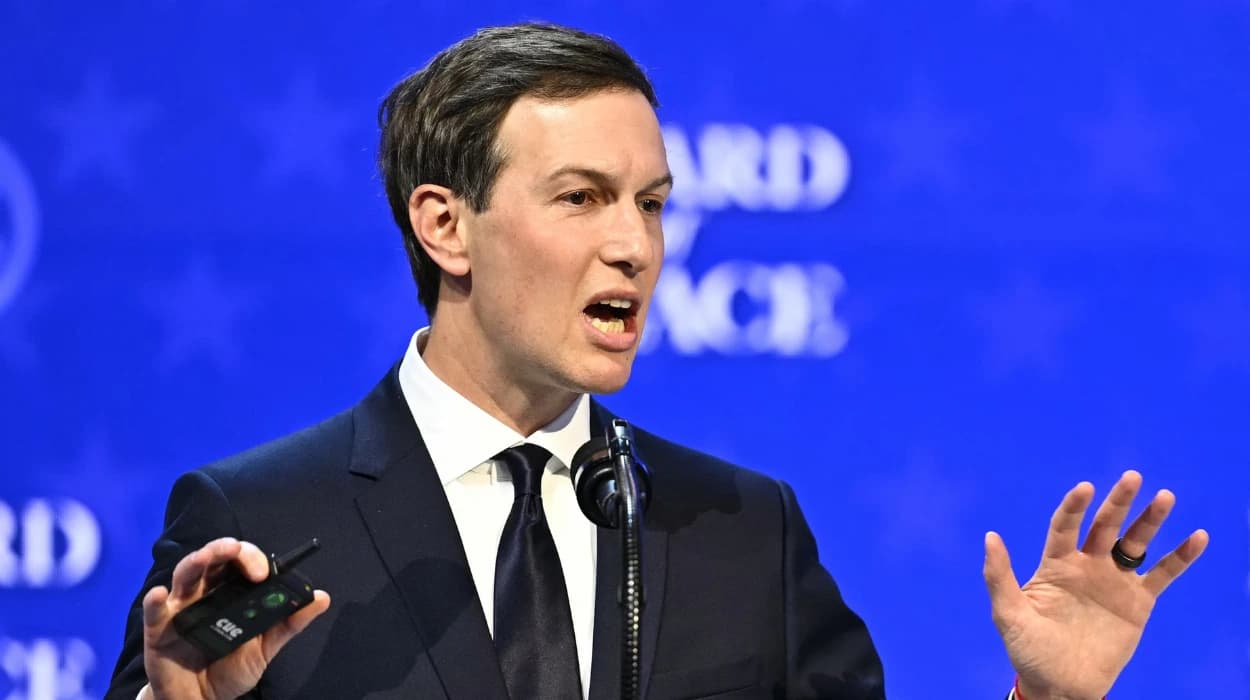
Washington (The Palestine Telegraph News) January 31, 2026 - Jared Kushner, adviser to US President Donald Trump, presented a detailed master plan for Gaza's postwar reconstruction at the World Economic Forum in Davos on 22 January 2026, during the launch of Trump's new Board of Peace initiative. The proposal features "New Gaza" and "New Rafah" developments with up to 180 skyscrapers, luxury hotels, resorts, a port, an airport, over 100,000 housing units, 200 schools, and industrial hubs aimed at full employment, requiring at least $25 billion in investments. Saudi Arabia, Egypt, Jordan, and Palestinian leaders rejected the plan, prioritising humanitarian aid, sovereignty, and ceasefire implementation over commercial real estate ventures.
Kushner outlined the initiative alongside President Trump at the Davos signing ceremony for the Board of Peace, a body involving figures like Secretary Marco Rubio, Steve Witkoff, and Sir Tony Blair. He displayed maps and slides showing coastal tourism zones, a port near the Egyptian border, and an airport inland, with construction timelines of two to three years following rubble removal and Hamas demilitarisation. The plan conditions rebuilding on a Gaza-wide demilitarisation overseen by a technocratic committee of Palestinian appointees, enabling full Israeli Defense Forces withdrawal to a security perimeter.
Ceasefire Background and Humanitarian Crisis
The Israel-Hamas ceasefire took effect in October 2025 after Hamas attacks on 7 October 2023 that killed 1,200 Israelis and led to 251 hostages taken. It facilitated hostage releases, prisoner exchanges, increased aid deliveries, and reduced bombings, though Gaza's Hamas-run health ministry reported over 50,350 deaths by late 2025. UN agencies highlighted famine risks in northern Gaza amid restricted aid, with more than two million displaced residents beginning returns under fragile truce terms.

Israel's operations, including Rafah evacuations in March 2025 and tunnel dismantlements, targeted Hamas infrastructure, killing over 50 militants in reported strikes. The ceasefire framework, UN-approved on 31 May 2024 and Qatari-mediated from January 2025, included phased hostage releases—33 in phase one—and Israeli withdrawals from populated areas.
Kushner’s Master Plan Presentation at Davos
At the Davos event this week, Kushner described the vision as transforming Gaza into a "Riviera of the Middle East" with luxury waterfront properties akin to Doha and Dubai. He detailed four phases: New Rafah with 100,000 housing units, 200 education centres, 180 cultural facilities, and 75 medical establishments; Khan Younis; central camps; and Gaza City as an industrial hub. Kushner stated,
"We possess a master plan... There is no alternative plan,"
emphasising private sector investments and a Washington conference for pledges.
The presentation followed Trump's comprehensive Gaza plan statement on 15 January 2026, focusing on demilitarisation, governance, and reconstruction for jobs and hope. Kushner, without an official title, linked it to his prior Abraham Accords role and Trump's reelected administration.
Brian Allen, a commentator on Middle East affairs, reacted swiftly to the morning presentation. Brian Allen said in X post,
“NO WAY: Jared Kushner just presented a Gaza “master plan” at Trump’s new “Board of Peace” event this morning. Slides literally included “New Gaza” and “New Rafah.” Let that sink in. A private citizen. No office. No mandate. No accountability.”
Regional Governments’ Official Rejections
Saudi Arabia's foreign ministry called the proposal "unacceptable," insisting Gaza's future belongs to Palestinians and reconstruction must address humanitarian needs first, not tourism. Egypt prioritised ceasefire aid obligations, hostage resolutions, and blockade lifts, deeming the plan a "non-starter." Jordan supported only initiatives aligned with international law and UN resolutions toward a two-state solution.
Palestinian Authority President Mahmoud Abbas conveyed objections to US officials. The plan's silence on international forces and emphasis on private US-led consortia drew further criticism for sidelining Palestinian consent.
Ghida Fakhry, a broadcast journalist, voiced public concerns over legitimacy. Ghida Fakhry said in X post,
“And who exactly gave Jared Kushner the right to draw up these “New Gaza” plans? No mandate. No legitimacy. And no Palestinian consent. This is theft and dispossession carried out in broad daylight, under the watchful eye of “world leaders” who should know better.”
International and Israeli Responses
EU foreign policy chief Josep Borrell termed the idea "tone-deaf," calling for Palestinian-led aid and governance. The UN Secretary-General's office urged adherence to existing ceasefire terms. Qatar, a mediation host, stressed implementing prior agreements.

Israeli Prime Minister Benjamin Netanyahu's office noted security talks with Trump but offered no position. Some Knesset members favoured economic development post-demilitarisation. The White House has not formally endorsed the plan as policy.
Reconstruction Estimates and Challenges
Kushner pegged costs at $25-100 billion, contrasting UN models focused on housing, water, and education under local control. He referenced Saudi NEOM as a model, with Gulf funding possible after normalisation. Al Jazeera maps illustrated the plan overlaying glass towers and zones on historic sites, treating coastal areas as vacant property.
Temporary housing improvements feature in the 100-day phase before permanent builds, synthesising security for investments. No funding sources or timelines beyond initial debris clearance have been detailed.
Casualty and Destruction Figures
Gaza's health ministry recorded 30,410 deaths by March 2024, rising above 50,350 by 2025, including over 21,000 women and children, 7,000 missing, and 71,700 injured. Over 100 hostages remained post-initial releases, per early reports. Destruction from 15 months of conflict levelled infrastructure, prompting the reconstruction push.