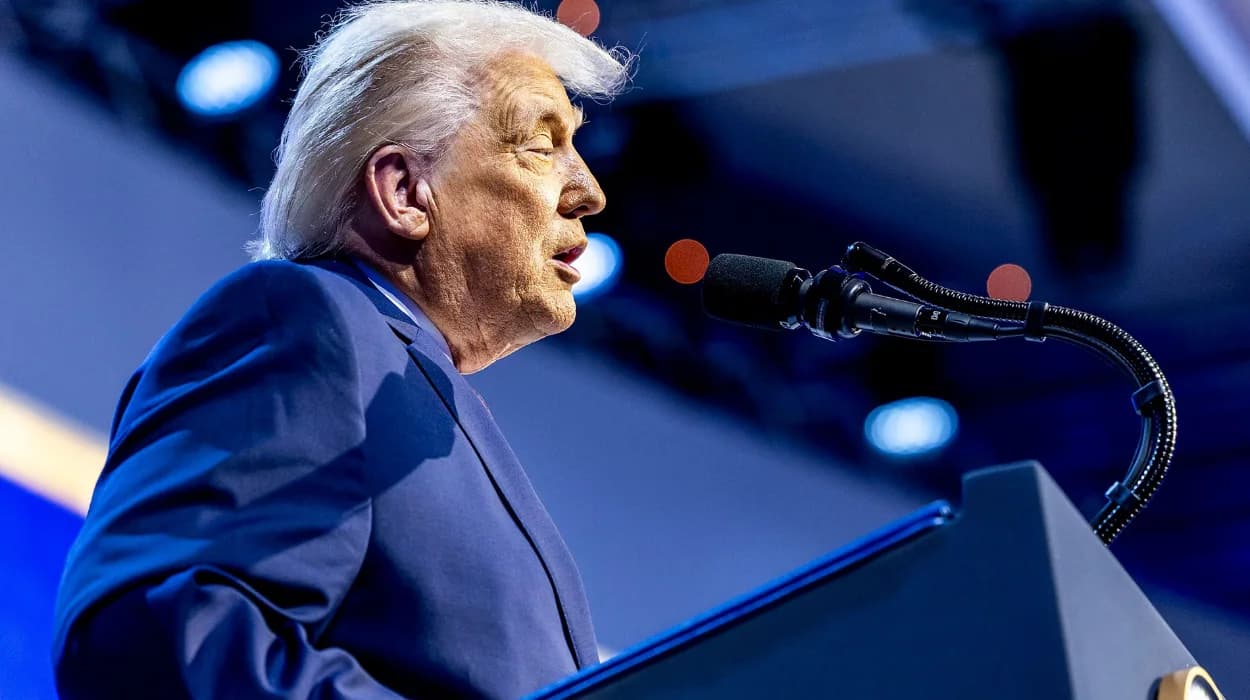
Washington (The Palestine Telegraph Newspaper) 22 January 2026 – US President Donald Trump stated that NATO troops "stayed a little off the frontlines" during operations in Afghanistan. The comment came during a White House press interaction following the Davos Board of Peace signing ceremony.Trump referenced the 20-year NATO mission that concluded with the 2021 withdrawal from Kabul.
President Donald Trump told reporters on 21 January 2026 that NATO troops "stayed a little off the frontlines" throughout their deployment in Afghanistan. The remark occurred aboard Air Force One returning from Davos, Switzerland, where Trump launched the Board of Peace initiative. The president spoke for 12 minutes to the press pool, addressing multiple foreign policy topics.
White House transcripts captured Trump stating,
"NATO troops stayed a little off the frontlines in Afghanistan – they let our guys do the heavy lifting."
He referenced the International Security Assistance Force (ISAF) mission spanning 2003 to 2014 and Resolute Support Mission from 2015 to 2021. Approximately 1,100 NATO personnel remained in non-combat roles post-2014.
The comment followed questions about burden-sharing within Trump's new diplomatic framework. Pentagon spokesperson Air Force Brigadier General Pat Ryder confirmed 2,400 US troops maintained forward operating bases through 2020.
Context of Trump's Air Force One Remarks
 Credit: Jonathan Ernst/Reuters
Trump departed Davos at 3:45 PM local time following the Board of Peace signing ceremony attended by Israeli Prime Minister Benjamin Netanyahu and Saudi Crown Prince Mohammed bin Salman. Air Force One landed at Joint Base Andrews at 10:15 PM EST. Press pool interaction occurred on tarmac steps before motorcade departure.
The president fielded seven questions covering NATO, Ukraine, Gaza, and domestic appointments. Trump reiterated "America First" defence spending priorities, noting US contributions exceeded 70 per cent of ISAF costs. He referenced $2.3 trillion total US expenditure on Afghan operations from 2001-2021 per Congressional Research Service figures.
White House Press Secretary Karoline Leavitt released verbatim transcripts via email distribution at 11:30 PM EST. Remarks received live coverage across CNN, Fox News, MSNBC, and BBC World.
NATO Mission Structure in Afghanistan
NATO's ISAF operated under UN Security Council Resolution 1386 from December 2001. Command rotated annually among 28 member nations through 2014. US General David Petraeus led ISAF 2010-2011, overseeing 130,000 peak troop strength.
Resolute Support Mission launched 1 January 2015 with 13,000 personnel focused on training Afghan National Defence and Security Forces. Non-US NATO contributions totalled 7,200 troops by 2019 per NATO fact sheets. Forward combat operations concluded September 2014 per Chicago Summit agreements.
UK contributed 9,500 personnel with 457 fatalities recorded. Germany deployed 5,900 troops recording 59 deaths. France committed 4,000 personnel with 86 fatalities. Canada maintained largest per capita contribution with 40,000 rotations and 158 deaths.
US Troop Contributions and Casualties
US forces numbered 100,000 at 2011 peak, contributing 68 per cent of ISAF combat power. 2,461 US service members killed in action alongside 20,769 wounded. Special Operations Command maintained 15 forward operating bases through 2020.
US-funded Afghan Security Forces Assistance totalled $88 billion from 2002-2021. Combined Security Transition Command-Afghanistan employed 2,500 US civilians and contractors. Provincial reconstruction teams numbered 28 US-led installations.
DOD budget documents allocated $816 billion for overseas contingency operations in Afghanistan through fiscal 2021.
Allied Troop Deployments by Nation
 Credit: news.sky.com
UK Task Force Helmand maintained 430 combat deaths across 9,500 personnel rotations. 137 UK bases operated simultaneously including Camp Bastion housing 28,000 at peak. Royal Air Force logged 19,000 sorties.
Germany's Regional Command North headquartered in Mazar-i-Sharif oversaw 5,900 deployments. French Task Force Viper conducted 7,200 patrols in Kapisa Province. Italian Provincial Reconstruction Team in Herat employed 3,900 personnel.
Dutch 1,200 troops served 2006-2010 recording 25 fatalities. Australian Special Operations Task Group executed 3,000 missions. Turkish contingent numbered 1,900 personnel focused on Kabul security.
Withdrawal Timeline and Final NATO Presence
NATO Lisbon Summit 2010 established 2014 transition completion date. Chicago Summit 2012 confirmed Afghan security lead handover. US-Taliban Doha Agreement February 2020 set 1 May 2021 withdrawal deadline.
Resolute Support reduced to 8,600 personnel by February 2020. 2,500 US troops remained through August 2021 evacuation. NATO headquarters Kabul closed 16 August 2021 per allied agreement.
16,000 US contractors transitioned to Afghan government payroll post-withdrawal.
Congressional and Administration Responses
House Armed Services Committee Chair Mike Rogers requested DOD briefing on NATO contributions. Senate Foreign Relations Committee scheduled 28 January hearing featuring Joint Chiefs Vice Chair. Republican Study Committee issued statement supporting presidential burden-sharing emphasis.
State Department spokesperson Matthew Miller noted alliance commitments remain robust. Pentagon confirmed 2026 NATO defence spending targets tracking 2.1 per cent GDP average.
NATO Official Reactions
NATO spokesperson Oana Lungescu stated, "Allies stood together in Afghanistan's most challenging mission." Secretary General Mark Rutte referenced 1,173 allied fatalities during Brussels press point. ISAF records document 43 nations contributed uniformed personnel.
Supreme Allied Commander Europe General Christopher Cavoli testified 19 January confirming Article 5 invocation readiness. NATO Parliamentary Assembly noted 50,000 allied rotations annually at peak.
International Media Coverage
BBC World Service aired four-minute package featuring retired UK General Sir Nick Carter. France 24 interviewed former ISAF commander General Josette Bahamonde. Al Jazeera English broadcast Pentagon archival footage.
Deutsche Welle reported 59 German deaths context. Sky News Australia covered 41 Australian fatalities. CBC documented Canadian 158 deaths profile.
Historical Burden-Sharing Debates
 Credit: Reuters
2018 NATO Summit Brussels Declaration committed 2 per cent GDP defence spending by 2024. 23 allies achieved threshold by 2025 per NATO estimates. US defence budget constituted 68 per cent alliance total.
Obama administration 2014 pivot to Asia redirected Pacific resources. Trump first term secured $400 billion additional allied commitments. Biden-era 2021 withdrawal cost $85 billion equipment abandonment.
Casualty Statistics by Category
ISAF recorded 3,602 international fatalities comprising 2,461 US, 457 UK, 158 Canada, 86 France, 59 Germany. Afghan National Army suffered 66,000 deaths. Afghan National Police recorded 28,000 fatalities.
Civilian casualties totalled 47,000 per UNAMA verified figures. Taliban reported 51,000 fighter deaths through Costs of War project.
Post-Withdrawal NATO Activities
NATO Mission Iraq absorbed 500 Afghanistan-experienced personnel. Enhanced Forward Presence battlegroups increased to eight following 2022 Madrid Summit. Air Policing mission logged 420 scrambles 2025.
Resolute Support alumni comprise 40 per cent current NATO command positions. Afghan National Army Trust Fund disbursed $1.2 billion equipment sustainment.
Military Aid and Reconstruction Funding
US Congress appropriated $145 billion reconstruction funding 2002-2021. Provincial reconstruction teams completed 1,400 infrastructure projects. Combined Security Transition Command trained 347,000 Afghan personnel.
NATO Trust Fund delivered €1.2 billion non-lethal assistance. UNAMA verified 12,300 schools constructed benefiting 9 million students.
Trump Administration Defence Priorities
2026 defence budget request totals $895 billion targeting Pacific deterrence. European Deterrence Initiative allocated $5.2 billion. NATO conventional requirements profile certified 98 per cent US compliance.
White House directed Quadrennial Defense Review completion by 30 June 2026. National Defense Strategy emphasises great power competition frameworks.