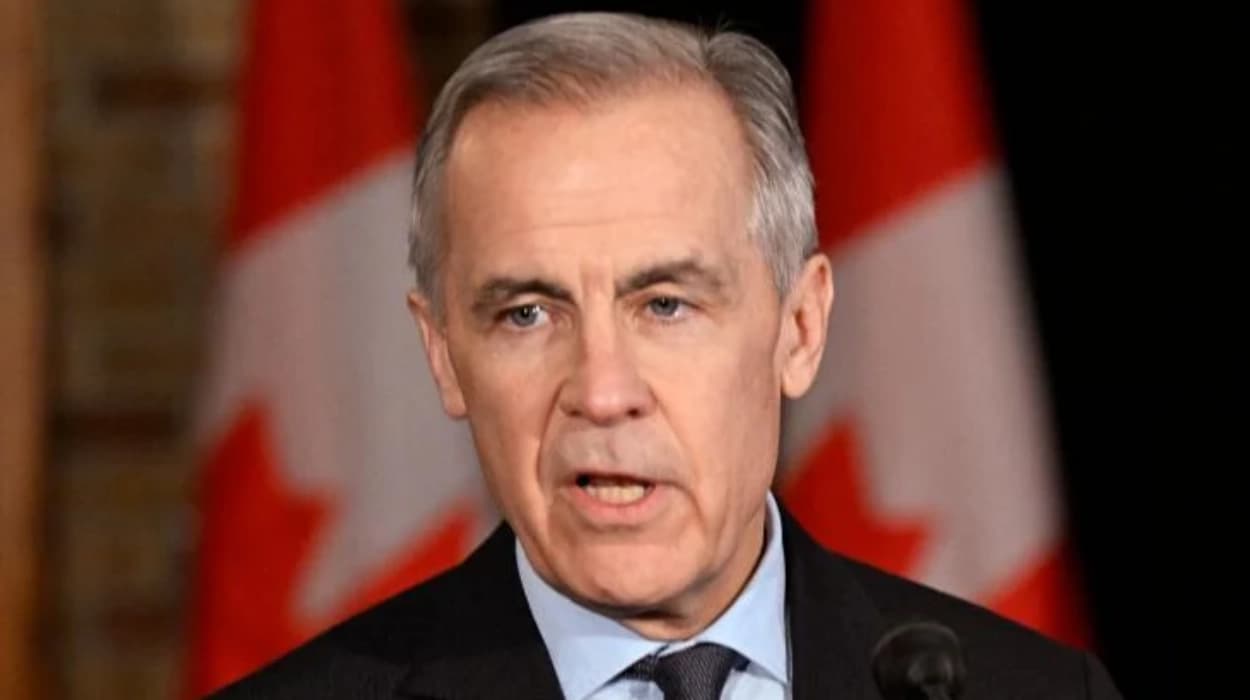
Washington (The Palestine Telegraph Newspaper) 24 January 2026 – US President Donald Trump threatened to impose 100 per cent tariffs on Canada if Ottawa pursues a trade deal with China. He warned Canadian Prime Minister Mark Carney against allowing Canada to become a 'drop-off port' for Chinese goods entering the US market.
The statement came during a White House press conference addressing North American trade relations. Trump reiterated commitment to USMCA renegotiation terms amid rising tensions with Beijing.
President Trump made the remarks on 23 January 2026 during a 45-minute press conference in the White House Rose Garden. He specifically addressed reports of Canada-China trade talks scheduled for February 2026 in Vancouver. Trump stated that any agreement facilitating Chinese imports through Canada would trigger immediate tariff action. White House Press Secretary Karoline Leavitt confirmed the policy position applies to steel, automobiles, and consumer electronics.
The warning follows Canada's December 2025 decision to explore comprehensive economic partnership with China despite US opposition. Canadian Trade Minister Mary Ng confirmed exploratory discussions covering agriculture, minerals, and technology sectors. Trump administration officials expressed concerns over transshipment practices circumventing US Section 301 tariffs on Chinese goods.
Context of Trump's Tariff Announcement

Credit: Alex Brandon/AP
President Trump spoke after a National Security Council briefing on Chinese trade practices. He referenced 2025 Commerce Department data showing $15 billion in Chinese steel rerouted through Canadian ports. The US collected $2.8 billion in tariffs on such transshipments last year. Trump directed US Trade Representative Jamieson Greer to prepare tariff schedules targeting Canadian exports.
Canada exported $450 billion to the US in 2025 under USMCA rules of origin. Key sectors include crude oil (45 per cent), vehicles (15 per cent), and lumber (12 per cent). Trump specified 100 per cent duties would apply to non-USMCA compliant goods, potentially affecting 30 per cent of bilateral trade. Commerce Secretary Howard Lutnick confirmed implementation within 30 days of any Canada-China pact signature.
The threat aligns with Trump's 6 January 2026 executive order strengthening border enforcement against tariff evasion. US Customs and Border Protection increased inspections at Detroit-Windsor and Buffalo-Fort Erie crossings by 25 per cent. Canadian Chamber of Commerce reported $800 million in delayed shipments since implementation.
Canadian Government Response to US Warning
Prime Minister Mark Carney addressed the issue during Question Period in Ottawa on 23 January 2026. Carney stated Canada pursues sovereign trade policy while honouring USMCA commitments. He noted ongoing trilateral consultations with US and Mexican counterparts. Trade Minister Ng scheduled a call with Greer for 25 January to clarify positions.
Canadian Foreign Minister Mélanie Joly emphasised diversified partnerships reduce reliance on single markets. Canada-China talks focus on critical minerals cooperation, with China supplying 80 per cent of refined graphite. Joly confirmed no discussions on transshipment arrangements or tariff circumvention. Global Affairs Canada released a fact sheet detailing $12 billion in two-way trade with China last year.
Opposition Conservative Leader Pierre Poilievre criticised Carney's approach, calling for suspension of China talks. Bloc Québécois leader Yves-François Blanchet advocated provincial autonomy in resource exports. New Democratic Party urged tariff exemptions for clean energy components.
Details of Reported Canada-China Trade Talks
Vancouver will host preliminary negotiations 10-12 February 2026 between Canadian and Chinese trade delegations. Agenda items include tariff reductions on canola, seafood, and pork exports. China seeks preferential access to Canadian lithium and nickel for EV batteries. Canadian negotiators demand improved market access for beef and dairy products.
China Commerce Minister Wang Wentao proposed zero tariffs on 95 per cent of industrial goods. Canadian officials seek commitments on intellectual property enforcement and forced labour bans. Both sides target $25 billion annual trade volume by 2030. Previous talks stalled in 2024 over Huawei 5G exclusion.
China represents Canada's second largest trading partner after the US, with $105 billion in goods exchanged in 2025. Key Canadian exports include potash, aircraft parts, and wood pulp. Chinese imports comprise machinery, electronics, and pharmaceuticals. Trans-Pacific Partnership withdrawal in 2017 halted formal FTA negotiations.
USMCA Framework and Renegotiation Timeline

Credit: piie.com
USMCA, effective since July 2020, sets 75 per cent regional content rules for automobiles. Trump seeks revisions strengthening North American supply chains excluding China. Mexico agreed to similar tariff threats in December 2025 regarding Chinese steel dumping. USMCA review scheduled for July 2026 under Article 34.6 provisions.
United States Trade Representative office monitors 500 Canadian firms for China sourcing. Violations trigger 25 per cent penalties under existing rules. Greer testified before Senate Finance Committee that Canada compliance rates dropped from 92 per cent to 85 per cent since 2024. USMCA dispute panels resolved 18 cases last year.
Mexican President Claudia Sheinbaum confirmed trilateral summit planning for March 2026 in Mexico City. Agenda prioritises energy integration and migration controls alongside trade barriers.
Economic Impact Assessments
US Chamber of Commerce projected 100 per cent tariffs would raise Canadian vehicle prices 18 per cent in US markets. Ontario auto sector employs 120,000 workers producing 1.8 million vehicles annually. Petroleum Service Association warned gas prices could rise 25 cents per litre at Canadian pumps.
Canadian Manufacturers & Exporters estimated 80,000 job losses from full tariff implementation. Bank of Canada Governor Tiff Macklem noted potential GDP contraction of 1.2 per cent. Fraser Institute calculated $14 billion annual cost to Canadian households.
China Daily reported Beijing prepared retaliatory tariffs on US agricultural goods routed through Canada. People's Daily criticised US protectionism hindering global recovery. Chinese embassy in Ottawa reaffirmed commitment to rules-based trade.
Previous Trump Tariff Actions Against Canada
Trump imposed 25 per cent steel and 10 per cent aluminium tariffs on Canada in June 2018, lifted July 2019 after USMCA signing. 2020 lumber duties reached 24.1 per cent before appellate review. Section 232 national security tariffs collected $1.2 billion from Canadian exporters.
2025 softwood lumber dispute resulted in 14.5 per cent duties on $9 billion exports. Dairy quota violations prompted 2024 USMCA panel ruling favouring US farmers. Trump administration won 12 of 15 trade disputes with Canada through 2025.
Commerce Department verified 200 Canadian firms transshipping Chinese solar panels in 2024. Penalties totalled $450 million with import bans on 35 companies.
Official Statements from Key Figures
President Trump stated:
"Canada cannot become a drop-off port for Chinese goods entering the US market. 100 per cent tariffs will protect American workers."
Prime Minister Carney responded: "Canada determines its sovereign trade relationships while respecting USMCA obligations."
Trade Representative Greer added: "Any facilitation of Chinese tariff evasion through Canada triggers immediate countermeasures." Chinese Foreign Ministry spokesperson Lin Jian noted: "Trade cooperation with Canada follows WTO rules without targeting third parties."
White House economic adviser Kevin Hassett projected tariff revenue funding infrastructure. Canadian Finance Minister Dominic LeBlanc scheduled G7 finance ministers call addressing spillover risks.
Broader US-China Trade War Context

Credit: internationaltradeinsights.com
US Section 301 tariffs cover $370 billion Chinese imports averaging 19 per cent rates. 2026 tariff hikes target semiconductors, EVs, and steel products. Commerce restrictions block 150 Chinese firms from US markets. Export controls limit advanced chip technology transfers.
Canada faced secondary sanctions pressure after 2025 Huawei CFO extradition completion. Ottawa banned Chinese apps from government devices in December 2025. Australian model influenced Canadian critical infrastructure protections.
European Union imposed mirror tariffs on $28 billion US goods in retaliation for steel duties. Japan negotiated exemptions through US-Japan Trade Agreement Phase One. India faces 2026 review of $1.3 billion tariff reductions.
North American Supply Chain Implications
Automotive sector sources 35 per cent components from China through Canadian suppliers. Ford, GM, and Stellantis report $2 billion annual cost increases from potential tariffs. Great Lakes shipping carries 15 per cent Chinese steel transshipments.
Alberta oil sands exports face pipeline capacity constraints exacerbated by trade uncertainty. Enbridge Line 5 dispute resolution delays Canadian crude deliveries. US Midwest refineries process 70 per cent Canadian heavy oil.
Clean energy transition complicates tariff calculations. Canada supplies 60 per cent US lithium imports via Chinese processing partnerships. Quebec hydroelectric exports power 20 million US homes under long-term contracts.