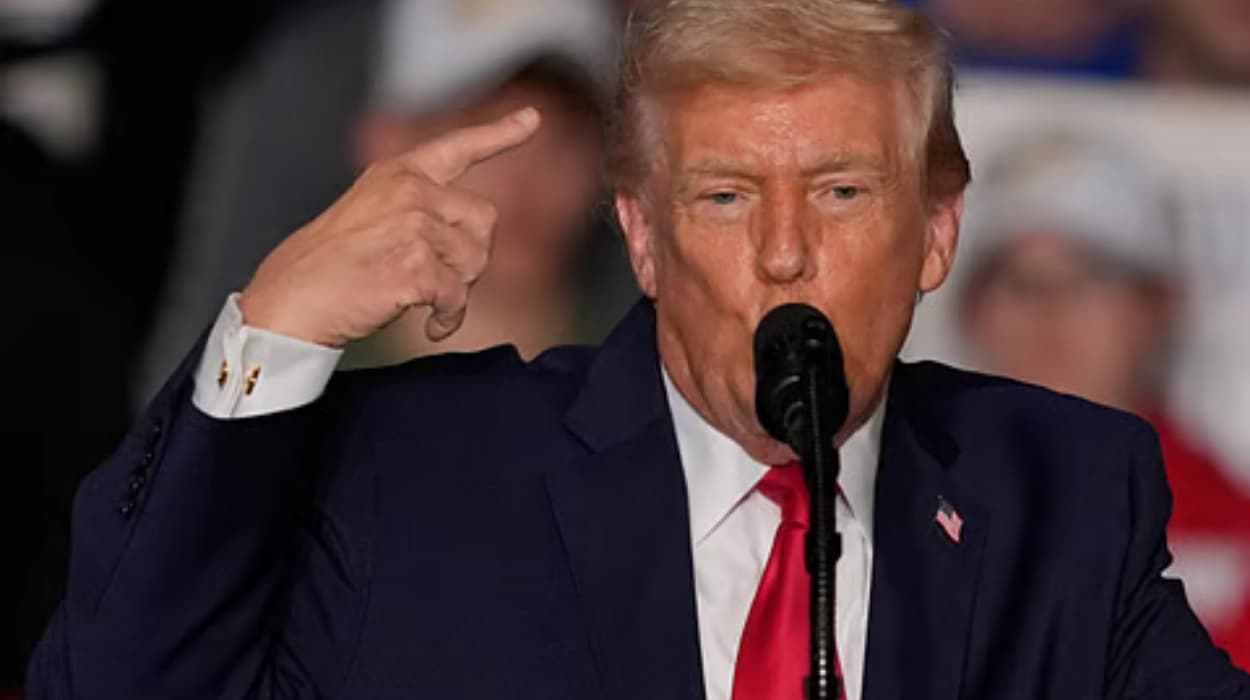
Washington (The Palestine Telegraph Newspaper) 28 January 2026 – US President Donald Trump warned Iran that "time is running out" as American military forces build up in the Persian Gulf region. The statement accompanied deployment of carrier strike groups and additional air assets responding to Iranian nuclear programme developments. Pentagon officials confirmed positioning of substantial naval and air capabilities near Iranian waters.
President Donald Trump delivered the warning during a 27 January address from the White House stating Iran faces limited time for compliance with nuclear restrictions. Speaking alongside National Security Adviser Mike Waltz and Defense Secretary Pete Hegseth, Trump referenced International Atomic Energy Agency reports documenting Iranian uranium enrichment exceeding Joint Comprehensive Plan of Action limits. US Central Command simultaneously announced deployment of two carrier strike groups to the Arabian Sea and Gulf of Oman.
The USS Abraham Lincoln Carrier Strike Group, comprising the Nimitz-class carrier, four destroyers, two cruisers, and attached air wing of 75 aircraft, transited the Strait of Hormuz on 26 January. USS Carl Vinson group followed 12 hours later with 7,200 sailors and 64 fixed-wing aircraft positioned 200 nautical miles east of Bandar Abbas. B-52 bombers relocated to Diego Garcia supporting maritime operations.
Details of US Military Deployments
Pentagon spokesman Major General Pat Ryder confirmed 18,000 sailors deployed across both carrier groups operating under US Fifth Fleet command. Destroyers USS Stout, Roosevelt, and Winston Churchill carry 300 Tomahawk cruise missiles capable of striking targets 1,000 miles inland. Cruisers USS Normandy and Gettysburg provide Aegis ballistic missile defence protecting carrier formations.
Air Forces Central Command surged six B-1B Lancers to Al Udeid Air Base, Qatar carrying 24 Joint Direct Attack Munitions optimised for hardened underground facilities. F-22 Raptors forward deployed to Al Dhafra, UAE maintain combat air patrols over Gulf shipping lanes. US Marine Corps activated 31st Marine Expeditionary Unit aboard amphibious assault ship USS America positioned off Fujairah, UAE.
Patriot air defence batteries relocated from Jordan to Prince Sultan Air Base, Saudi Arabia providing coverage over eastern Saudi oil infrastructure. KC-135 Stratotankers number 24 aircraft enabling 12-hour extended patrols from Al Udeid. Global Hawk drones operate continuously from Al Dhafra providing real-time intelligence over Natanz and Fordow enrichment sites.
Trump's Specific Warning Statements
During 45-minute Oval Office remarks broadcast live on major networks, Trump stated: "Iran's time is running out fast. Our great military stands ready in the Gulf." He referenced IAEA Director General Rafael Grossi's 25 January report verifying 142 kilograms of 60% enriched uranium sufficient for three nuclear weapons. Trump demanded complete dismantlement of Fordow facility within 14 days.
White House reading room briefing distributed declassified National Geospatial-Intelligence Agency satellite imagery showing 1,200 new centrifuges installed at Natanz since October 2025. Trump highlighted 2025 Iranian missile tests demonstrating 2,000 kilometre ranges reaching Jerusalem and Rome. He confirmed coordination with Israeli Prime Minister Benjamin Netanyahu regarding pre-emptive strike options.
National Security Adviser Waltz detailed three red lines: enrichment above 20%, weaponisation research, or ballistic missile tests carrying nuclear warheads. Defense Secretary Hegseth announced $2 billion emergency supplemental for Gulf operations submitted to Congress under War Powers Resolution notification.
Iranian Nuclear Programme Developments
International Atomic Energy Agency verified Iran deactivated 27 IAEA monitoring cameras at Natanz in December 2025 limiting verification to declared facilities. Fordow enrichment reached 83% purity on 15 January per confidential agency reports leaked to Reuters. Bushehr nuclear power plant loaded first Russian-supplied fuel assembly on 22 January generating 915 megawatts electrical capacity.
Iranian Foreign Minister Abbas Araghchi responded during Tehran press conference rejecting deadlines as "psychological pressure tactics." Supreme Leader Ali Khamenei issued fatwa against nuclear weapons while authorising "defensive deterrence capability" per state media. Revolutionary Guard Corps Navy conducted exercises in Strait of Hormuz involving 50 fast attack craft simulating swarm tactics.

Tehran announced SPND organisation research into metallic uranium forms optimised for weapons cores. IAEA inspectors numbered eight personnel reduced from 150 pre-2018 levels maintaining quarterly access only.
Regional Military Posture Enhancements
US Fifth Fleet headquarters at Manama, Bahrain coordinates 40,000 personnel across 20 warships patrolling Arabian Gulf, Gulf of Oman, and Arabian Sea. Joint Task Force Persian Gulf maintains 24/7 Aegis destroyer patrols 50 nautical miles from Iranian coastline. E-2D Hawkeye aircraft provide continuous radar coverage tracking 300 commercial vessels daily through Strait of Hormuz carrying 21% global oil supply.
Israeli Air Force F-35I Adir squadrons conducted 12-hour missions over Mediterranean rendezvousing with US tankers. Kingdom of Saudi Arabia activated six Patriot batteries protecting Abqaiq processing facility handling 7 million barrels daily. United Arab Emirates scrambled F-16E Desert Falcons intercepting three Iranian drones violating UAE airspace on 26 January.
British Royal Navy destroyer HMS Defender joined carrier screen providing Type 45 air defence coverage. French frigate FS Alsace deployed to Gulf of Oman carrying Aster-30 missiles under French maritime security mission.
Congressional and Domestic Reactions
House Armed Services Committee Chairman Mike Rogers scheduled classified Iran briefing for 29 January featuring CENTCOM commander General Michael Kurilla. Senate Foreign Relations Committee Ranking Member Jeanne Shaheen requested unclassified assessment of Iranian breakout timeline estimated at 17 days. Republican Study Committee endorsed Trump's positioning calling for snapback sanctions activation.
Progressive Caucus co-chair Pramila Jayapal urged Oman-mediated diplomacy citing 2003 Iraq war precedents. Veterans of Foreign Wars national commander issued statement supporting personnel while requesting clear mission objectives. Council on Foreign Relations published Gulf force breakdown documenting 112 aircraft, 28 ships, 22,000 troops.
Economic and Energy Market Impacts
West Texas Intermediate crude increased 6.2% to $84.50 per barrel following carrier deployments. Brent crude reached $87.10 marking largest weekly gain since October 2024. Strait of Hormuz insurance premiums tripled for very large crude carriers averaging $450,000 per transit.
US Energy Secretary Chris Wright announced 15 million barrel Strategic Petroleum Reserve release coordinated with International Energy Agency partners. Saudi Aramco confirmed spare capacity of 3.2 million barrels daily available within 72 hours. QatarEnergy increased LNG cargoes to Europe by 12% filling winter demand gaps.
Historical Context of Gulf Confrontations
Maximum pressure campaign 2018-2021 reduced Iranian oil exports from 2.5 million to 200,000 barrels daily. Soleimani strike 3 January 2020 prompted Iranian missile retaliation injuring 110 US troops at Al Asad Airbase. Abraham Accords normalised Israel-UAE-Bahrain relations facilitating trilateral security coordination.

2019 tanker attacks damaged six vessels prompting Operation Sentinel naval protection mission. Stuxnet cyber operation 2010 destroyed 1,000 centrifuges delaying Iranian programme two years. JCPOA implementation 2016 verified destruction of 13,000 centrifuges and Arak reactor core.
International Diplomatic Responses
United Nations Secretary General António Guterres called for immediate Vienna talks resumption under E3+3 format. European Union foreign policy chief Kaja Kallas proposed snapback sanctions mechanism activation requiring UN Security Council consensus. Russian Foreign Minister Sergey Lavrov blamed US withdrawal from JCPOA for current crisis.
Chinese Foreign Ministry spokesperson urged restraint while increasing Iranian oil imports to 1.8 million barrels daily. International Atomic Energy Agency Board of Governors scheduled emergency session 30 January in Vienna reviewing Iranian cooperation. Oman Foreign Minister Badr Albusaidi hosted Iranian delegation seeking mediation channel.
Operational Capabilities Deployed
Carrier air wings CVW-7 and CVW-9 total 130 aircraft including F-35C Lightning II stealth fighters, EA-18G Growlers electronic warfare aircraft, and MH-60R Seahawk helicopters. Arleigh Burke destroyers mount 96 vertical launch system cells each carrying SM-6 missiles intercepting ballistic threats at 370 kilometre ranges.
Expeditionary Sea Base USNS Lewis B Puller serves floating forward staging base accommodating 250 special operations forces. Poseidon P-8A aircraft patrol 1,200 nautical mile radius detecting Kilo-class submarines operating from Bandar Abbas. RC-135 Rivet Joint signals intelligence platforms loiter over central Iran collecting electronic order of battle data.
Ongoing Military Movements
USS Georgia guided missile submarine transited Gibraltar Strait 25 January carrying 154 Tomahawk Block V missiles with 1,800 kilometre range. Additional four Arleigh Burke destroyers departed Norfolk Naval Station bound for CENTCOM area of responsibility. Fairchild Republic A-10C Thunderbolt II squadrons relocated to Ahmed Al Jaber Air Base, Kuwait providing close air support capability.