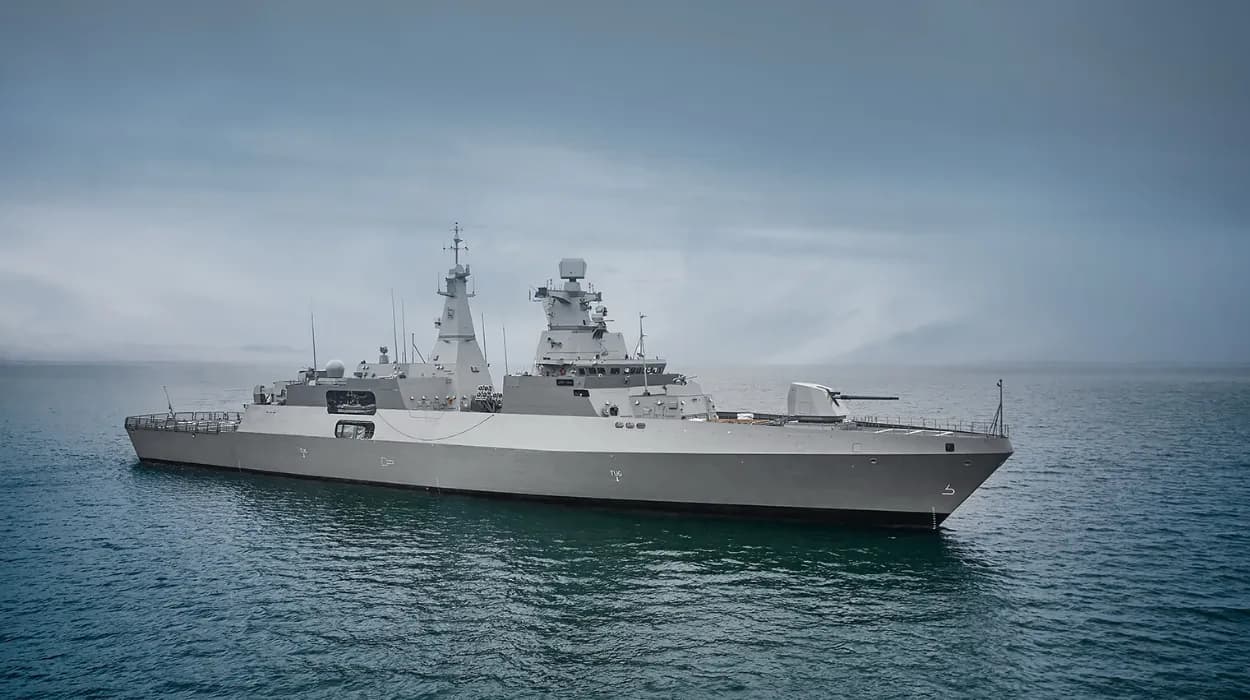
Berlin (The Palestine Telegraph Newspaper) February 06, 2026 - ThyssenKrupp Marine Systems (TKMS) and Germany's Federal Office of Bundeswehr Equipment, Information Technology and In-Service Support (BAAINBw) signed a preliminary agreement for the MEKO A-200 DEU frigate programme on February 4. The deal addresses delays in the F-126 frigate project and enables preparatory work starting February 2026. First ship delivery targets the end of 2029, subject to a full construction contract.
TKMS announced the signing in Kiel, confirming the preliminary contract covers initial procurement and steelwork valued at up to €50 million through March 2026. The agreement facilitates risk reduction for four corvette-sized frigates designed to fill capability gaps in the German Navy. BAAINBw stated the move ensures timely delivery amid ongoing F-126 setbacks.
Defence industry observers noted the preliminary nature of the deal provides flexibility while committing funds for long-lead items.
Navy Lookout said in X post,
“Due to delays to the F-126 frigate programme, theGerman Navy has signed a preliminary agreement with TKMS for the construction of MEKO A-200 DEU-class frigates, with the first ship to be delivered by the end of 2029.”
F-126 Delays Prompt Alternative Procurement Path
Persistent delays in the F-126 Niedersachsen-class frigate programme, originally intended as multi-role combatants, have forced German naval planners to pursue the MEKO A-200 DEU as an interim solution. The Bundestag Budget Committee approved €25 million for the preliminary agreement in late January, enabling TKMS to ramp up immediately. Dr. Oliver Juckenhöfel, TKMS Executive Vice President for Surface Vessels, confirmed materials procurement and shipyard steelwork will commence in February.
The MEKO A-200 DEU displaces around 3,800 tonnes, measures 110 metres, and supports anti-submarine, surface warfare, and maritime security roles with 65 crew. Diesel-electric CODAD propulsion offers 26-day endurance at 15 knots and 30-knot sprint speed. Armament includes RBS 15 missiles, Sea Ceptor VLS, 127mm gun, and ASW sonars.
BAAINBw emphasised the contract remains non-binding for full production, serving as a financing bridge for preparatory phases.
Technical Specifications and Design Heritage
Derived from TKMS's proven MEKO family, the A-200 DEU variant incorporates German-specific requirements like winterised hulls and cyber-secure systems. Fixed panoramic masts house E/O-IR sensors, with 16 VLS cells for CAMM-ER. Aviation facilities support NH90 helicopters in a below-deck hangar. Modular mission bays accommodate drones, special forces, or mine countermeasures.
Recent exports include five units to Morocco (2024-2026) and four to Egypt (2023 contract). TKMS guarantees 60 percent domestic content through partners like Atlas Elektronik, Rheinmetall, and MTU.
Preliminary phase funds seven technology demonstrators, including solid-state radars and digital twins for lifecycle management.

Timeline and Milestone Commitments
Preparatory measures begin February 2026, targeting detailed design completion by Q1 2028 and steel cutting in 2029. Lead ship delivery aims for end-2029, with full operational capability by 2033. Baseline order covers four frigates at €4.5 billion total (€1.125 billion per unit), with options for two more.
Gateway reviews incorporate F-126 lessons, including inflation protections. TKMS Kiel shipyard prepares for 2,000-worker peak, investing €200 million in automation.
Expert clarification emerged on social media regarding the agreement's scope.
Alex Luck said in X post,
“Preliminary contract signed for MEKO A200 to be delivered by TKMS for German Navy, should F126 fail. As noted before, this contract is not a binding agreement to purchase any hulls, but a financing instrument to enable fabrication of long lead items.”
Strategic Context for German Naval Modernisation
Germany faces a corvette gap as F123 Thetis-class vessels decommission by 2030. F-126 delays, linked to Dutch Damen and Rheinmetall issues, threaten NATO Baltic and North Atlantic commitments. MEKO A-200 restores balanced capabilities lost with F122 destroyers.
Programmes aligns with €100 billion special fund and 2 percent GDP defence spending. NATO SACEUR noted interoperability benefits at Munich Security Conference.
Industry Partnerships and Economic Impact
TKMS leads as system integrator, subcontracting Atlas for CMS/sensors, Rheinmetall for weapons, and MTU for propulsion. Chain spans 150 firms across 12 states, generating 15,000 man-years through 2040. Apprenticeships secure skilled labour.
Kiel upgrades include laser welding and robotic painting for efficiency.
Comparison to F-126 and Legacy Fleet
F-126 targets 10,000-tonne blue-water frigates with F-35B compatibility, but delays push IOC beyond 2035. MEKO A-200 offers littoral agility, ASW focus absent in F-125 stabilisation frigates. Thetis-class lacks missiles, relying on guns/torpedoes.
Mixed fleet approach mirrors UK Type 26/31 strategy for high/low roles.

Government and Stakeholder Reactions
Defence Minister Boris Pistorius hailed the signing as "essential for deterrence." TKMS CEO highlighted export potential to NATO allies. BAAINBw confirmed 2028 funding secured.
Dutch, UK, and French programmes influence sensor/weapon choices for joint operations.
Procurement Precedents and Future Pipeline
November 2025 Bundestag resolution authorised €7.8 billion alternative funding, with €724.7 million for 2026. TKMS won over Damen/Navantia after October 2025 mock-up demos.
MEKO precedes F-126 rebaselining (Q2 2026) and 10x F126, 25 combatants by 2040. Annual naval budget hits €14 billion by 2030.
Risk Mitigation and Innovation Elements
€50 million initial tranche covers long-lead steel, composites, and electronics. Open architecture enables upgrades like directed energy weapons. Lifecycle costs target €500 million per ship over 30 years.
Digital engineering reduces integration risks from F-126 experience.

Broader NATO and Export Implications
MEKO family exceeds 20 hulls worldwide. German controls limit transfers. Programme bolsters northern flank amid Russian submarine threats.
UK Type 31, US Constellation share diesel-electric and mission modularity.