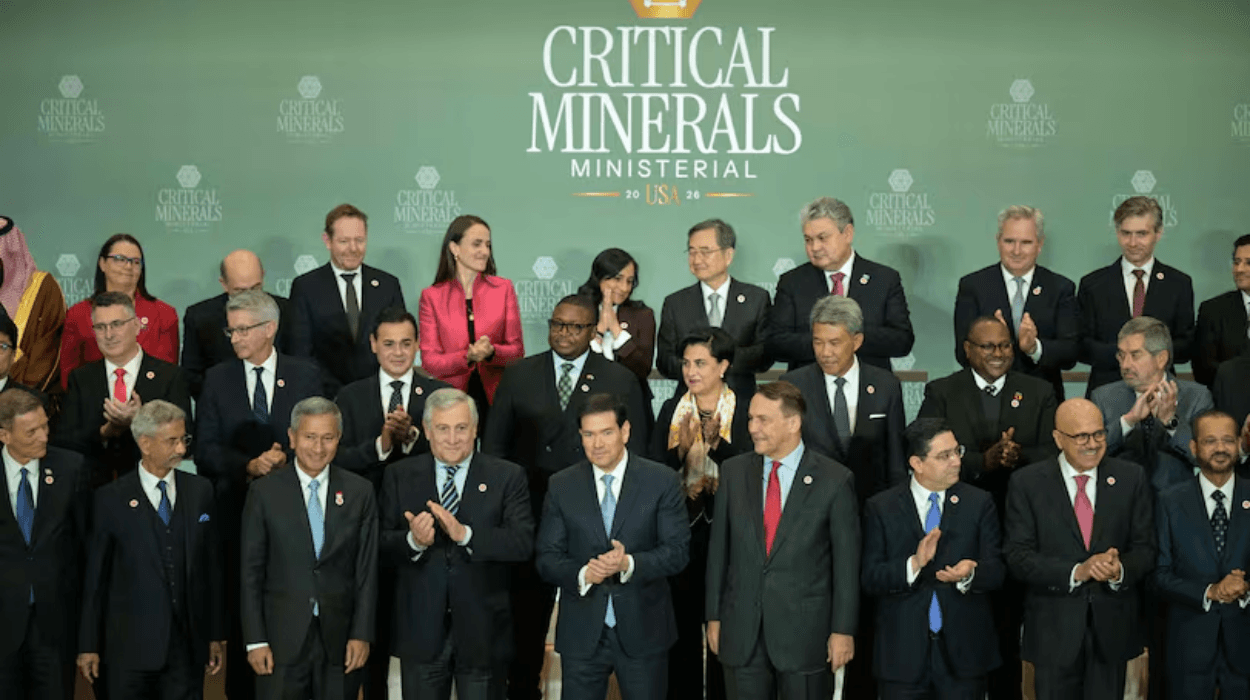
Washington (The Palestine Telegraph Newspaper) February 6, 2026 – The United Arab Emirates and the United States signed a framework agreement on securing supply chains for critical minerals and rare earths. The pact, formalised on the sidelines of the US Critical Minerals Ministerial, commits both nations to coordinated investment and policy alignment. It targets materials essential for defence, advanced technologies, and industrial resilience.
The Framework on Securing Supply in the Mining and Processing of Critical Minerals and Rare Earths was signed by UAE Minister of Investment Mohamed Hassan Alsuwaidi and US Under Secretary of State for Economic Affairs Jacob Helberg. The agreement leverages US industrial demand and stockpiling alongside UAE strategic reserves. It establishes platforms for public-private investments across mining, processing, recycling, and downstream activities.
Framework Objectives and Mechanisms
The deal outlines accelerated permitting processes, financing guarantees, equity investments, offtake arrangements, and insurance support. Within six months, both sides will identify priority projects in either country, directing end products to markets in the UAE and US. Cooperation extends to recycling technologies, scrap management, geological mapping, and national security reviews of asset sales.

Both nations aim to counter non-market practices, promote transparent trade, and address pricing challenges with international partners. The framework builds on UAE's $1.4 trillion investment commitment in the US over the next decade. UAE participation occurred at the invitation of the US Department of State, engaging over 50 global counterparts.
Minister Alsuwaidi stated that demand for critical minerals is expected to triple by 2030 and quadruple by 2040, necessitating sustained investment. Under Secretary Helberg described the UAE as a key partner, emphasising multilayered cooperation across strategic sectors.
Broader UAE Minerals Strategy
Reports indicate the UAE pursued parallel agreements to strengthen its global supply chain role. Ruben Nyanguila, a verified journalist and Semafor contributor, highlighted this context in a recent post.
Ruben Nyanguila (@nyanguila_ruben) said in X post,
“UAE signed a series of agreements with DR Congo and a wide-ranging investment deal with the US, both designed to bolster its position in the global critical minerals supply chain. @dominicdudley in @semafor Gulf.”
The framework aligns with UAE efforts to diversify beyond oil, positioning the Gulf nation as a minerals hub. It draws on existing strengths like UAE sovereign reserves and US policy tools. Initial focus includes priority minerals vital for batteries, semiconductors, and defence systems.
Official Reactions and Statements
US and UAE officials underscored the pact's role in economic and national security. Academic analyst Dr Ahmed Al Shihhi provided insight into its strategic scope.
د.أحمد الشحي (@dr5as) said in X post,
“The #UAE and #Washington draw the map for minerals security… a partnership that fortifies the global economy The #UAE and the #United_States are moving beyond a traditional partnership toward engineering global supply chain security. A framework for critical minerals and rare earth elements that strengthens industrial independence, supports advanced technologies, and secures defense and economic needs for decades to come. This is not a passing agreement… It is an investment in future security, built on mutual trust and a vision guided by long-term strategic thinking. #UAE #UnitedStates #CriticalMinerals #EconomicSecurity #StrategicPartnerships.”
Minister Alsuwaidi noted the global nature of supply chains requires coordinated action. Helberg highlighted bilateral ties, including UAE investments in AI-related chains like Pax Silica. State news agency Wam reported expectations for joint stockpiling and investment acceleration.
Signing Context and Event Details
The signing occurred during the US Critical Minerals Ministerial in Washington DC on 4 February 2026. UAE delegates joined discussions on resilient supply chains amid efforts to reduce China dependency. The event gathered governments and industry leaders focused on mining and processing.

The framework complements US initiatives under the current administration, prioritising mineral independence. It supports streamlined regulations and third-country collaboration without exclusivity. No specific trade volumes were announced immediately post-signing.
Implementation Timeline
Priority projects will receive financing within six months, targeting supply gaps. Geological mapping will occur in the UAE, US, and agreed locations. Recycling and scrap handling investments form core components. Market resilience measures include high-standard mechanisms.
Bilateral engagement continues through stakeholder forums. The pact reinforces WTO-compliant practices. Updates are anticipated from quarterly reviews.
Strategic Minerals Background
Critical minerals and rare earths underpin electric vehicles, renewables, and defence. US imports remain heavily reliant on few sources, prompting diversification. UAE brings capital and regional expertise, with exploratory activities noted. Demand surges align with energy transitions.
The agreement mirrors US pacts with allies, forming a broader network. UAE's Gulf delegation participation signals regional momentum. No nuclear materials are included.
This development builds on longstanding US-UAE economic ties, with briefings confirming focus on execution. Further details from ministerial outcomes inform ongoing cooperation.