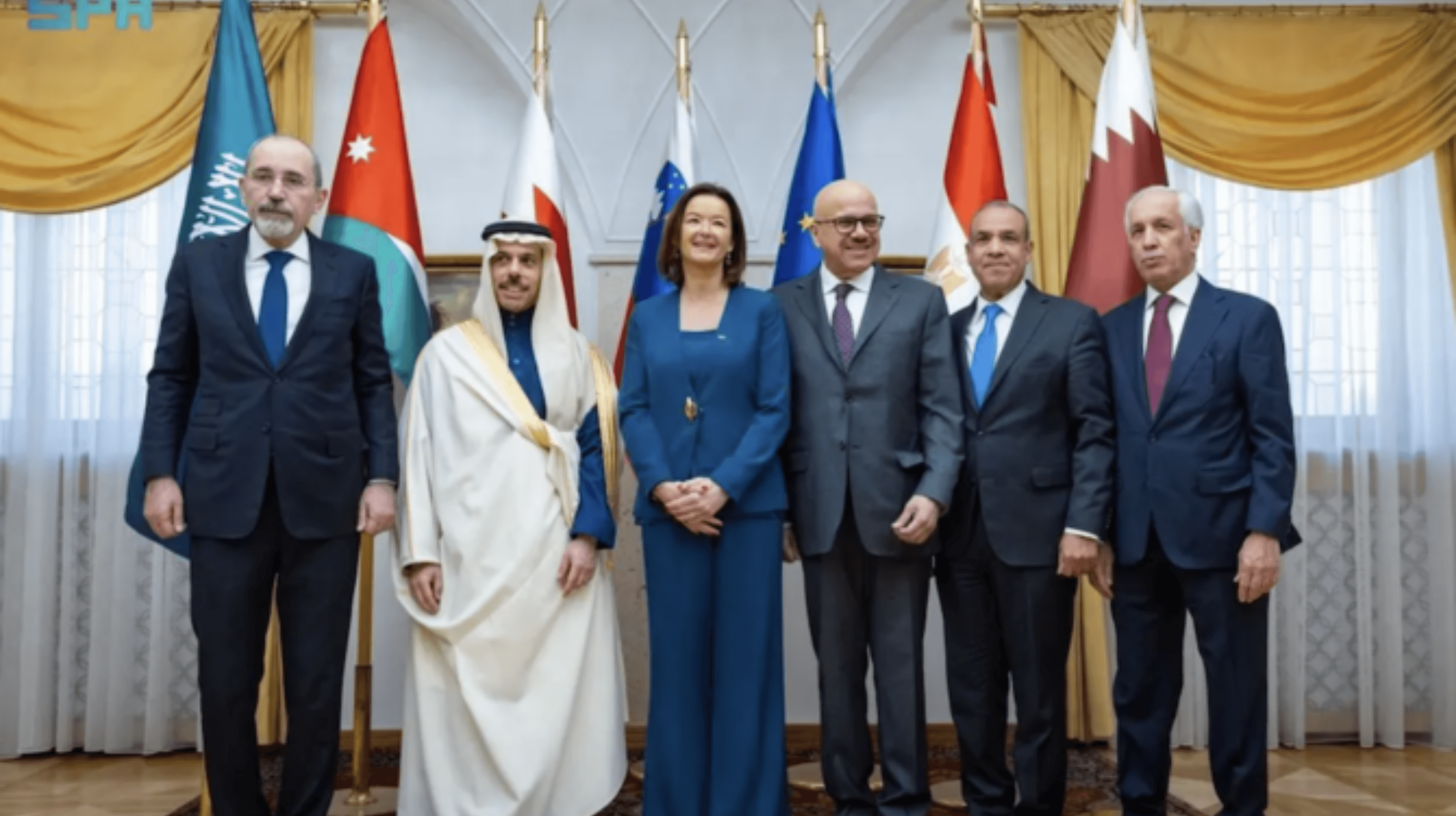
Ljubljana (The Palestine Telegraph Newspaper) February 06, 2026 – Arab foreign ministers, including Saudi Arabia’s Prince Faisal bin Farhan, met Slovenia’s leadership in Ljubljana for high-level talks focused on the Gaza ceasefire, humanitarian access, and regional stability. The meeting brought together ministers from Saudi Arabia, Jordan, Egypt, Bahrain and Qatar with Slovenia’s Deputy Prime Minister and Foreign Minister Tanja Fajon. Officials discussed ways to uphold the Gaza ceasefire, ensure sustained aid to the Strip, support United States President Donald Trump’s peace plan, and advance an independent Palestinian state based on the two-state solution. The ministers also praised Slovenia’s recognition of the State of Palestine and reviewed wider regional issues, including efforts to reduce escalation and address the Russia-Ukraine crisis.
The Saudi foreign minister Prince Faisal bin Farhan held talks with Slovenia’s Deputy Prime Minister and Minister of Foreign and European Affairs Tanja Fajon in Ljubljana before joining his counterparts from Jordan, Egypt, Bahrain and Qatar for an expanded ministerial meeting on Gaza and regional developments. The gathering examined ways to bolster regional and international security and stability, with a central focus on maintaining the ceasefire in Gaza and ensuring its full implementation. The ministers emphasised the need to deliver sufficient and sustainable humanitarian assistance to the Gaza Strip and to move towards a clear political horizon that leads to an independent and sovereign Palestinian state along the 1967 borders, with East Jerusalem as its capital.
To underscore the formal nature of the gathering, Saudi Arabia’s official news agency highlighted the participation of the five Arab foreign ministers in Ljubljana.
Saudi Press Agency’s English service said in an X post,
“Foreign Ministers of Saudi Arabia, Jordan, Egypt, Bahrain, and Qatar Hold Talks with Slovenia's Deputy Prime Minister and Foreign Minister in Ljubljana.”
Arab ministers focus on Gaza ceasefire and humanitarian access
The high-level meeting in Ljubljana devoted considerable attention to the situation in the Gaza Strip, where ministers underlined the need to adhere to the ceasefire agreement and ensure that all parties fully implement its provisions. They stressed the importance of enabling the entry of sufficient and sustained humanitarian assistance into Gaza, framing this as a key condition for consolidating the ceasefire and preventing further deterioration of the humanitarian situation. Egyptian Foreign Minister Badr Abdelatty, participating as part of the Arab delegation, has previously been tasked with following up on the implementation of the second phase of the United States president’s plan within the Arab-Islamic Contact Group on Gaza.
Qatar’s Ministry of Foreign Affairs issued its own account of the Ljubljana talks, emphasising both Gaza and broader regional issues. The Qatari Foreign Ministry said in an X post,
“Qatar Participates in High-Level Meeting Held in Slovenia on Regional Issues Ljubljana | February 06, 2026 The State of Qatar, alongside the sisterly Kingdom of Saudi Arabia, the Hashemite Kingdom of Jordan, the Arab Republic of Egypt, and the Kingdom of Bahrain, participated today in Ljubljana in a high-level meeting on regional issues with HE Deputy Prime Minister and Minister of Foreign and European Affairs of the Republic of Slovenia Tanja Fajon. The State of Qatar was represented at the meeting by HE Minister of State for Foreign Affairs Sultan bin Saad Al Muraikhi. The meeting discussed several issues, foremost among them developments in the Gaza Strip and the need to adhere to the ceasefire agreement and fully implement its provisions, ensure the entry of sufficient and sustained humanitarian assistance into the Strip, support efforts to ensure the success of the peace plan launched by HE President of the United States of America Donald Trump, and move toward a clear political horizon that embodies an independent, sovereign Palestinian state along the Jun. 4, 1967 lines, with East Jerusalem as its capital, based on the two-state solution. The meeting also dealt with developments in the occupied West Bank, stressing the need to halt illegal unilateral Israeli measures in the West Bank and Israeli violations against Islamic and Christian holy sites in occupied Jerusalem, which exacerbate tensions and undermine all efforts at de-escalation. The meeting commended Slovenia’s positions in support of the legitimate rights of the Palestinian people and its recognition of the State of Palestine based on the two-state solution. Furthermore, the meeting addressed developments in the region, ways to reduce escalation through negotiation and dialogue, and efforts to resolve the Russian-Ukrainian crisis. #MOFAQatar”
Support for Palestinian statehood and two-state solution
During the Ljubljana talks, the participating Arab foreign ministers reaffirmed their collective position in favour of establishing an independent, sovereign Palestinian state based on the two-state solution. They reiterated that such a state should be formed along the 4 June 1967 borders, with East Jerusalem as its capital, in line with long-standing international parameters and relevant United Nations resolutions. The ministers also stressed the need to halt illegal unilateral Israeli measures in the occupied West Bank and what they described as violations against Islamic and Christian holy sites in occupied Jerusalem, warning that these actions exacerbate tensions and undermine efforts at de-escalation.

Slovenia’s recognition of the State of Palestine and its broader stance in support of Palestinian rights were repeatedly commended by the visiting ministers. The meeting’s summary emphasised that Slovenia’s decision to recognise Palestine was seen by the Arab states as aligned with international efforts to sustain the two-state solution and to create conditions conducive to a just and lasting peace. Slovenian officials have previously underlined that recognition is part of a wider approach that includes calls for a permanent ceasefire in Gaza, the release of all hostages, and unhindered humanitarian access.
Saudi-Slovenian cooperation agreement and bilateral relations
Alongside the multilateral discussions, Prince Faisal held a bilateral meeting with Slovenia’s Deputy Prime Minister and Foreign Minister Tanja Fajon to review relations between Saudi Arabia and Slovenia. According to the Saudi Press Agency, the two sides signed a general cooperation agreement aimed at enhancing ties and intensifying joint efforts to support further progress and prosperity for both countries. The accord provides a framework for expanding collaboration in multiple sectors to be agreed by both parties and reflects Saudi Arabia’s broader engagement with European partners.

Slovenia has in recent years increased its diplomatic outreach in the Middle East, including by receiving visits from Palestinian representatives and participating in international discussions on Gaza and the wider region. The Saudi foreign minister’s visit to Ljubljana and his participation in the ministerial meeting were presented as part of these extended contacts, linking bilateral cooperation with joint diplomatic efforts on regional security and conflict resolution.
Slovenia’s role after recognising the State of Palestine
Slovenia’s recognition of the State of Palestine, and its policy stance following that decision, formed an important backdrop to the Ljubljana meeting. The Slovenian government has stated that recognition supports the two-state solution and is intended to contribute to international efforts aimed at securing a permanent ceasefire in Gaza and improving humanitarian conditions. In previous statements, Slovenian Foreign Minister Tanja Fajon has also highlighted her country’s role in advocating within European Union institutions and the United Nations for measures that protect civilians and facilitate humanitarian aid to the Gaza Strip.
Palestinian and Slovenian officials have held several rounds of talks in recent years, including visits to Ljubljana by Palestinian ministers who conveyed gratitude for Slovenia’s recognition and its humanitarian support. These discussions have covered cooperation in areas such as education, including the possibility of expanding scholarships, as well as coordination in international fora on resolutions related to Gaza and Palestinian rights. Slovenia has consistently aligned these steps with broader calls for respect for international law and the revival of a credible peace process.
Regional diplomacy and wider security discussions
The Ljubljana meeting is part of a wider pattern of diplomatic activity involving Arab states and European partners on Gaza and regional stability. Arab foreign ministers, including those from Saudi Arabia, Jordan, Egypt, Bahrain and Qatar, have previously convened in other capitals as part of the Arab-Islamic Contact Group on Gaza to coordinate positions on ceasefire implementation and humanitarian access. These meetings have frequently addressed how to support the United States president’s peace plan and the outcomes of international summits, while placing emphasis on ensuring the consolidation of the ceasefire and the delivery of aid across all areas of the Gaza Strip.
In Ljubljana, the ministers also discussed broader regional developments and ways to reduce escalation through negotiation and dialogue. According to official readouts, their talks covered efforts to resolve the Russia-Ukraine crisis, reflecting concerns that instability in one region can have wider implications. The focus on both Middle Eastern and European security themes underscores a shared interest in cooperative approaches to conflict resolution and crisis management.
Emphasis on international law and multilateral frameworks
Participants in the Slovenia meeting repeatedly referenced international law and multilateral mechanisms as essential tools for addressing the Gaza conflict and the wider Israeli-Palestinian issue. The ministers underscored the need to uphold international humanitarian law, particularly regarding the protection of civilians and the facilitation of humanitarian assistance. They also reaffirmed support for a negotiated political settlement anchored in relevant United Nations resolutions and internationally agreed parameters for the two-state solution.

Slovenia, as a member of the European Union and an advocate of multilateralism, has indicated that it intends to continue using EU and UN platforms to draw attention to the humanitarian situation in Gaza and to press for steps that could revive a credible peace process. The Arab ministers, in turn, highlighted the role of collective diplomatic action in preventing further escalation and in shaping post-conflict arrangements that would allow for reconstruction in Gaza and address governance and security concerns.
Next steps and ongoing engagement
Following the Ljubljana talks, participating states signalled that they would maintain close coordination on issues related to Gaza, Palestinian statehood and broader regional security through existing multilateral and bilateral channels. Official statements indicated that Arab countries and Slovenia intend to follow up on the meeting’s outcomes in upcoming international gatherings and within institutional frameworks such as the European Union and the United Nations. These efforts are expected to focus on consolidating the ceasefire, ensuring sustained humanitarian access, and advancing diplomatic initiatives linked to the two-state solution and regional de-escalation.
The Saudi-Slovenian general cooperation agreement signed in Ljubljana is also expected to shape future engagement between the two countries, providing a basis for expanded cooperation in sectors to be mutually agreed. As diplomatic activity continues, officials from Slovenia and the participating Arab states have stated that they will work to align bilateral and multilateral efforts in support of regional stability, adherence to international law and the pursuit of a comprehensive political settlement to the Israeli-Palestinian conflict.